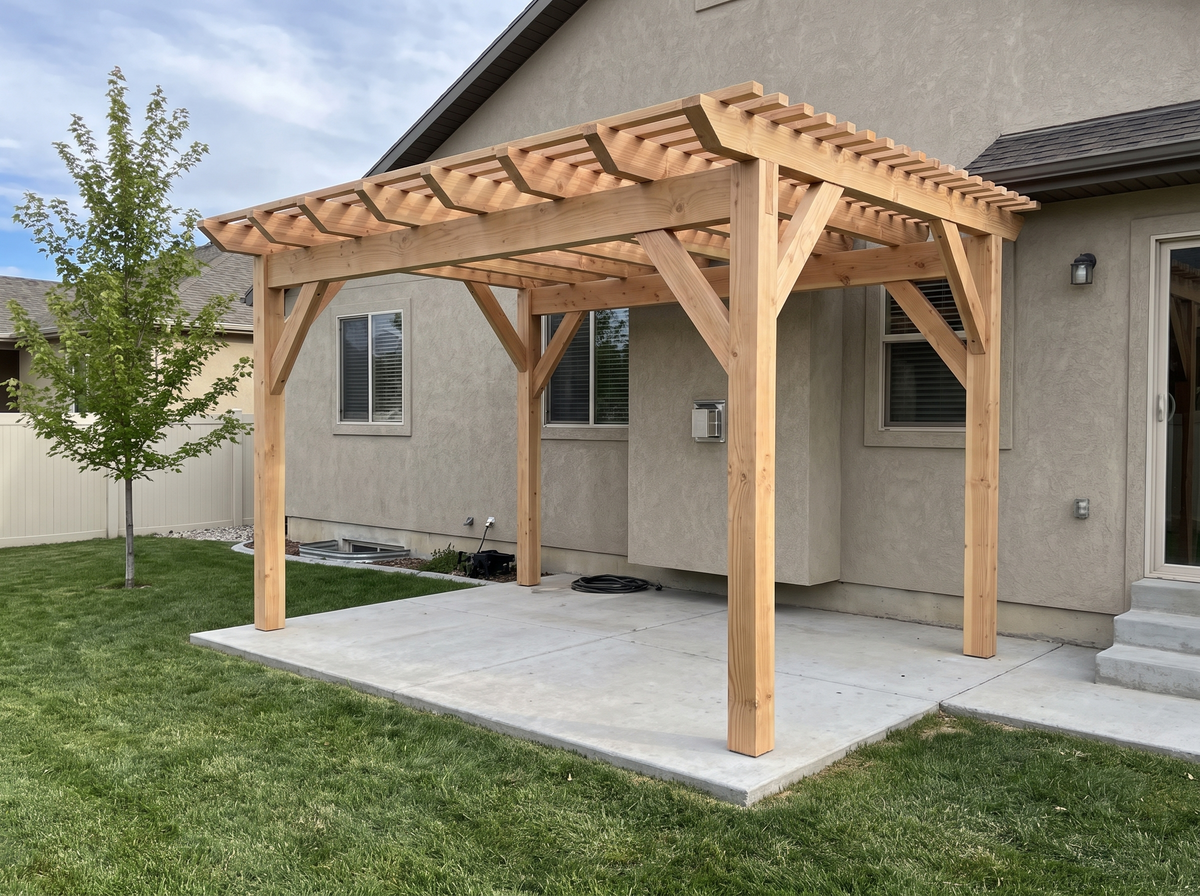
Building without a required permit in a Utah city is an infraction, and the 2026 Utah Uniform Fine Schedule sets the recommended fine at $350. Your city then adds its own penalty on top, most commonly a doubled permit fee. But most detached backyard pergolas under 200 square feet never needed a permit at all, so the first question is whether you have a violation.
Key takeaways
- This guide covers what happens after a backyard structure gets built without a permit in Utah: the legal classification, the penalties city by city, how to permit it after the fact, and what it does at resale. For whether your pergola needs a permit in the first place, see the Utah pergola and pavilion permit guide.
- In a Utah city it is an infraction. No jail is possible, the fine is capped at $750, and the courts recommend $350. In unincorporated county it is charged as a class C misdemeanor.
- The city penalty is separate from the state fine, and it varies a lot. Salt Lake City can add up to 10% of the construction value. Greater Salt Lake MSD charges 200% of the permit fee plus a daily fee.
- Most detached pergolas under 200 square feet are exempt, so a large share of people reading this do not have a problem.
- Tear-down is driven by location, not paperwork. A structure that is only unpermitted can usually be permitted. A structure in a setback cannot be.
- After five years, Utah gives an unpermitted structure a narrow protection, but not the amnesty most people assume.
Did you actually need a permit?
Start here, because a good share of the people searching this question have not broken a rule.
Utah has adopted the 2021 International Residential Code statewide, and it exempts one-story detached accessory structures under 200 square feet from a building permit. A freestanding 12×16 pergola in the middle of a backyard usually falls inside that exemption. The full rule, including the 200-versus-120 confusion and how cities file a pergola in the first place, lives in the Utah pergola and pavilion permit guide.
Four situations put you outside the exemption:
- The structure is attached to the house. The exemption says detached. Bolt a pergola to a wall or a fascia and the exemption is gone at any size.
- It has a solid roof. A solid-roof pavilion or patio cover is generally treated as a patio cover rather than an open accessory structure, and cities usually require a permit for one. Orem's own permit list names porch and patio covers as requiring a permit, while its exemption is written for storage-type sheds.
- It is over the size threshold. A large pavilion clears 200 square feet quickly.
- It sits somewhere it should not. This is the one that catches people.
That last case deserves its own sentence, because it is where the exemption gets misread. Being exempt from a building permit does not exempt a structure from setbacks, height limits, lot coverage caps, easements, or HOA rules. A perfectly legal permit-exempt pergola built three feet from a rear property line, in a city that requires more, is still a code violation. It just is not a permit violation.
So before you assume the worst, get clear on which problem you have. They have very different fixes.
Is building without a permit illegal in Utah?
Yes, and Utah says so directly. Under Utah Code § 10-9a-802(2)(b), now recodified at § 10-20-1001, "it is an infraction to erect, construct, reconstruct, alter, or change the use of any building or other structure within a municipality without approval of a building permit."
The word infraction matters more than most homeowners realize. Under Utah Code § 76-3-205, a person convicted of an infraction may not be imprisoned. The penalty is a fine, and under § 76-3-301 the fine for an infraction is capped at $750. The 2026 Utah Uniform Fine Schedule published by the Utah courts lists the offense by name, 10-20-1001 BUILDING WITHOUT A PERMIT, as an infraction with a recommended fine of $350 and no required court appearance.
Counties work slightly differently. The same fine schedule lists the county equivalent, a violation of the County Land Use, Development, and Management Act at § 17-79-902, as a class C misdemeanor rather than an infraction, also at $350.
One thing does escalate the classification, and it is worth knowing before you make it worse:
| Situation | Classification | Maximum fine | Jail possible |
|---|---|---|---|
| Building without a permit in a city | Infraction | $750 | No |
| County land use violation, unincorporated area | Class C misdemeanor | $750 | Yes, up to 90 days |
| Continuing work after a stop-work order (West Valley City) | Class B misdemeanor | $1,000 | Yes, up to 6 months |
West Valley City's code is explicit about that last row: violations are infractions "except for a failure to comply with a stop-work order issued by the Department, which shall be a class B misdemeanor." Other Utah cities word it differently, but the pattern holds. Ignoring the red tag is treated far more seriously than the original mistake.
What building without a permit actually costs in Utah
The court fine is only one line on the bill. Your city or county charges its own penalty, and that is where the real money sits. Almost every Utah jurisdiction uses some version of the same idea: the permit you skipped now costs more than it would have.
Here is what four Wasatch Front jurisdictions publish, along with one central Utah county that shows the statewide pattern:
| Jurisdiction | Penalty for starting without a permit | Daily fees | Detail worth knowing |
|---|---|---|---|
| Salt Lake City | Up to 10% of construction valuation, or $1,000, whichever is greater | Not specified in the fee section | Paying the increased fee does not excuse compliance |
| Greater Salt Lake MSD (unincorporated Salt Lake County) | 200% of the permit fee | 1% of the permit fee per day, capped at $50 per day | Daily fees begin 10 business days after the notice of violation |
| Unincorporated Utah County | $300 investigation and red tag fee | Not specified | Drops to $75 if permit applications are filed within two business days of posting |
| West Valley City | Permit fee doubles | Yes, until the structure complies | Demolition is possible if the structure violates city ordinances |
| Sevier County | Investigation fee equal to the permit fee, plus the permit fee | Not specified | Included to show how consistent the doubling pattern is statewide |
Two of those rows are worth reading twice.
Salt Lake City Code § 18.20.090 lets the building official increase the fee "up to a fee of 10% of the valuation of the proposed construction as determined by the building official, or $1,000.00, whichever is greater." On a $30,000 pavilion, ten percent is $3,000. The same section adds that "the payment of such increased fees shall not relieve any persons from fully complying with the requirements of the code." You pay the penalty and you still bring the structure into compliance.
Unincorporated Utah County publishes something almost nobody mentions: the $300 investigation and red tag fee is "reduced to $75.00 if applications for required permits are filed within two (2) business days from the date of posting." If you get red-tagged in unincorporated Utah County, you are on a clock most homeowners never learn about, and moving fast saves $225.
Two honest caveats. First, fee schedules change, and every figure above is what that jurisdiction published as of the schedule cited. Call your city before you budget against it. Second, and more useful: the penalty fee is usually the cheapest part of the problem. The expensive parts are as-built drawings, an engineer's stamp if the city wants one, and any rework the inspection turns up. A doubled permit fee on a pergola is measured in hundreds. A structural correction is not.
Can a Utah city make you tear it down?
Legally, yes, and the statute is blunter than most people expect. Utah Code § 10-9a-802(1)(a) lets a municipality bring "injunctions, mandamus, abatement, or any other appropriate actions" and "proceedings to prevent, enjoin, abate, or remove the unlawful building, use, or act." Subsection (1)(b) adds the part that gets people's attention: "A municipality need only establish the violation to obtain the injunction." The city does not have to prove the structure hurt anyone. It only has to prove the violation exists.
In practice, forced removal is rare, and for a reason that has nothing to do with mercy. Demolition is slow and expensive for a city too. Building departments would overwhelmingly rather issue you a permit than take you to court.
What determines which way it goes is not how sorry you are. It is which kind of problem you have.
A permit can legalize a pergola. It cannot move one.
If the only defect is missing paperwork, a structure that meets code can almost always be permitted after the fact. If the defect is where the structure stands, no permit fixes it, because there is no permit for occupying a setback. The realistic tear-down and move-it triggers are:
- The structure sits inside a required front, side, or rear setback.
- It crosses a utility or drainage easement, which is often invisible on the ground and obvious on a plat.
- It pushes the lot past its accessory-structure or lot-coverage cap.
- It cannot be shown to meet structural requirements, and the fix costs more than a rebuild.
The first three are location problems. They are the ones worth checking before you build, and they are the reason placement gets drawn before anything gets cut.
Can you get a permit after it is already built?
Yes. It is usually called an after-the-fact permit or an as-built permit, and it is a normal thing for a Utah building department to process. The order of operations matters more than most people expect.
- Stop work. If you have been red-tagged, this is not optional, and continuing is the single step that escalates your exposure. The 2021 IRC requires that work "immediately cease" on notice, and continuing exposes you to the penalties under R113.4.
- Call the building department before you draw anything. Say plainly that you are permitting an existing structure. Departments handle this constantly and the conversation goes better when you lead with it.
- Answer the zoning question first. Setbacks, height, lot coverage, easements. Zoning is the one that cannot be engineered away, so confirm the structure is allowed where it is before spending money on drawings.
- Produce as-built drawings. These show what actually exists rather than what you meant to build: a site plan with dimensions and distances to property lines, post layout, beam and rafter sizes, and footing details.
- Expect to expose concealed work. An inspector cannot approve what they cannot see.
- Inspect, correct, close it out. Get the final sign-off in writing and keep it with your house records. That document is what makes the structure provable later.
For a pergola specifically, step five is unusually kind. Almost every guide about after-the-fact permits is written about finished basements and room additions, where opening concealed work means cutting into drywall and re-exposing wiring. An open-frame pergola conceals almost nothing. The joinery, the beams, the connections, and the rafters are all visible from the ground. The one thing buried is the footings, so the likely ask is excavating around a post base rather than demolishing a wall. That makes a pergola one of the cheaper structures to permit after the fact.
We are not going to tell you about the time a Wasatch Front city surprised us on a submittal, because it has not happened yet. What we can show you is the reading above, which is the homework a submittal is built from.
For what it is worth, permit preparation is part of a Stillbury build rather than a change order. The submittal gets prepared and filed as part of the project, and the structure carries a 3-year warranty once it is built. Both of those are easier to stand behind when the work is inspected and signed off, which is a practical argument for permitting that has nothing to do with fines. A closed permit is the document that proves the beams were sized right and the footings went where the drawings said.
What if the structure has been there for years?
This is the most common follow-up question, and it has a real answer in Utah that almost nobody publishes.
In 2024 Utah added a rule for what the statute calls a completed noncompliant structure, defined at Utah Code § 15A-1-104(1)(a) as a structure that was constructed and completed without obtaining a building permit, passing inspections, or obtaining a certificate of occupancy. Two provisions govern it:
| Provision | What it does |
|---|---|
| § 15A-1-104(3) | A municipality may not withhold a permit or project approval for a different project because of a completed noncompliant structure on the same property, provided the structure has been completed for five years or more, poses no health, life, or safety concern, is unrelated to and unaffected by the new project, and is outside its scope of work |
| § 15A-1-104(4) | A municipality may still require additional permitting, engineering, or inspections for the completed noncompliant structure itself if it has been completed for ten years or less, or if it poses a health, life, or safety concern |
Read those carefully, because the protection is narrower than it first sounds. Five years does not legalize the structure. What it does is stop the city from holding up an unrelated permit over an old unpermitted pergola. If you apply to remodel your kitchen and there is an eight-year-old pergola in the backyard that meets those four conditions, the city cannot hold the kitchen permit hostage over it. The pergola itself remains unpermitted, and under subsection (4) the city can still require permitting or engineering for the structure until it passes ten years, or at any time if it presents a safety concern.
One more provision in the same section is worth knowing, because it is a homeowner protection. Under § 15A-1-104(2), a compliance agency may not reject a permit or withhold project approval for noncompliance unless it "cites with specificity the applicable provision with which the project has failed to comply" and "describes how the project has failed to comply." You are entitled to a specific reason, in writing, not a general refusal.
Stillbury has not yet been asked to permit or replace a structure a homeowner built themselves. If you are in that position, the after-the-fact process above is the one we would walk through with you.
None of this is legal advice, and the outcome for any specific property depends on facts only your city can confirm. If a structure is close to one of these thresholds and real money rides on the answer, ask the building department in writing, or ask an attorney.
What an unpermitted pergola does when you sell
Two separate things happen at a sale, and they get conflated constantly.
The disclosure. Utah's Seller's Property Condition Disclosure asks at section 14A whether, cosmetic upgrades aside, you have "remodeled, made any room additions, made structural modifications or other alterations or improvements to the Property," and requires you to describe the work. Section 14B asks the same question about former owners, to your knowledge. A built structure in the backyard is an improvement. You describe it, and the buyer's next question is whether it was permitted. Answering that honestly is not optional, and a buyer who finds out later has a much bigger complaint than a buyer who was told up front.
The appraisal, which works differently than the internet suggests. Nearly all published guidance about unpermitted work is written about finished living space, where the argument is over gross living area and whether unpermitted square footage counts. A detached pergola is not living space, so that argument does not apply to it.
What does apply is the Fannie Mae Selling Guide, which requires that where an appraiser identifies an addition without a required permit, the appraiser "must comment on the quality and appearance of the work and its impact, if any, on the market value of the subject property." The same guide treats minimal outbuildings as acceptable when they are assigned little or no contributory value.
The practical translation for a backyard structure: the usual risk is not that an unpermitted pergola drags your appraisal down. It is that it contributes nothing. You paid for a structure and it appraises at zero. The more immediate friction is on the buyer's side, where a nervous buyer, agent, or lender asks for a price credit or asks you to permit it before closing, on your timeline and at your cost.
If your question is the broader one about whether a pergola adds value at all, that is a different question with a more encouraging answer, and it deserves its own treatment rather than a paragraph here.
Will homeowners insurance still cover it?
This is the section where the honest answer is less satisfying than the confident one you will read elsewhere.
Plenty of articles state flatly that a homeowners policy will deny a claim involving an unpermitted structure. We are not going to tell you that, because we cannot show you a Utah source that supports it as a general rule. What is fair to say is narrower. Coverage and claim outcomes are governed by your specific policy and carrier. Permit status is not usually a listed exclusion by itself, but it can become a live issue if a carrier is examining whether a structure was built to code after something goes wrong.
The useful action is small and cheap. Call your carrier, describe the structure, and ask how a permitted versus unpermitted detached accessory structure is treated under your policy. Ask for the answer in writing. That takes one phone call and it beats guessing from a blog, including this one.
What to do first if you get red-tagged
A red tag compresses the timeline. The after-the-fact permit steps above still apply, but three things change in the first 48 hours.
- Stop work immediately. Continuing after a stop-work order is the one action that makes your legal position worse rather than better, turning an infraction into a class B misdemeanor in cities like West Valley City.
- Find out whether you are on a clock. Unincorporated Utah County drops its $300 red tag fee to $75 if permit applications are filed within two business days of posting. Other jurisdictions set their own deadlines and none of them announce it twice. Ask on day one.
- Get the requirements in writing. Under § 15A-1-104(2) you are entitled to a specific citation and an explanation of how the structure fails it. A written list is also what keeps the scope from quietly growing between visits.
How to keep this from happening at all
The cleanest version of this problem is the one that never starts. Two questions handle most of it, and you can ask them of any company quoting you:
Who submits the permit? In Utah, if a licensed contractor is on the job, pulling the permit is normally their responsibility. Get it stated plainly in the contract rather than assumed. The permit guide covers how that responsibility divides in more detail.
What happens if the city asks for engineering? A solid roof, a long span, or a mountain-valley snow load can trigger an engineer's stamp. Ask now whether that is included in the quoted price or billed later.
There is also a structural reason kits and custom builds land differently here, and it is worth being fair about both. A pergola kit is genuinely cheap and genuinely fast, and for a small detached pergola well inside the exemption, the permit question may never come up. What a kit cannot do is look at your lot. It ships in a fixed catalog size, so the setback question, the lot coverage question, and the easement question all land on you after the box arrives.
A designed structure costs more and takes longer than a weekend, which is the honest trade. What you get for the wait is that the structure is drawn onto your actual lot before anything is cut, which is when placement problems surface on paper instead of in a notice taped to a post.
That is also the least dramatic reason to see a design before anything gets built. If you would like to see your exact pergola or pavilion on your exact patio, with its real placement drawn against your property lines, Stillbury's free 3D design and quote is the step where that gets checked. It costs nothing, and it is a much better place to discover a setback problem than in a notice taped to a post.
Most Utah backyard pergolas never needed a permit, and most of the ones that did can be permitted after the fact without much drama. The cases that get expensive are almost never the paperwork cases. They are the placement cases, where a structure ended up somewhere the zoning does not allow and no permit can fix it.
That is a problem that only exists before the posts go in. If you would like to see your structure drawn onto your actual lot, with setbacks and property lines accounted for, before anyone cuts a beam, the free 3D design and quote is where that happens.
Sources: Utah Code § 10-9a-802 (recodified § 10-20-1001), Enforcement · Utah Code §§ 76-3-205, 76-3-301, Utah Criminal Code, Punishments · 2026 Uniform Fine Schedule, Utah State Courts, Appendix C · Utah Code § 15A-1-104 (2nd Sub. H.B. 518, 2024), State Construction and Fire Codes Act · Salt Lake City Code § 18.20.090, Start of Work Without Permit; Penalty Fees · Greater Salt Lake Municipal Services District, FY2026 Fee Schedule · Utah County Fee Schedule and Ordinance · West Valley City Municipal Code § 19-1-105, Enforcement; West Valley City Building Inspections FAQ · Sevier County, Obtaining a Building Permit · City of Orem, When Do I Need a Building Permit? (December 2024) · Fannie Mae Selling Guide B4-1.3-05, Improvements Section of the Appraisal Report · Utah Seller's Property Condition Disclosure, Form 10, sections 14A and 14B · 2021 International Residential Code, Sections R113 and R114.