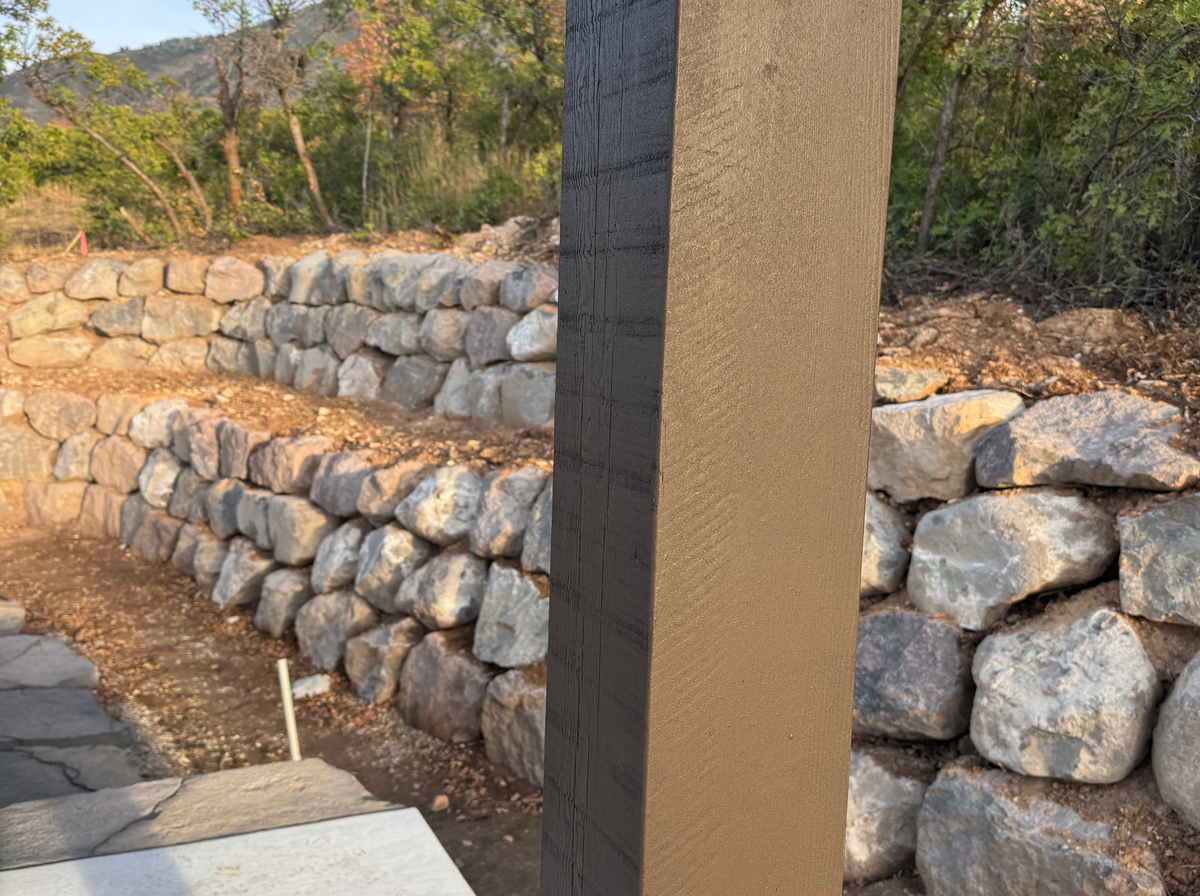
Those cracks running down your pergola's posts and beams are almost certainly seasoning checks, which are separations along the grain that form as wood dries. They are normal, they are not defects, and the engineers who set wood design values already assumed your timbers would develop them. This guide covers what is normal, what is not, and why Utah wood checks harder than most.
Key takeaways
- A check runs along the grain, is widest at the surface, and narrows toward the centre of the piece. A split goes through from one face to another. That difference decides whether to worry.
- Design values already assume the worst. The shear figures in the National Design Specification are set as though the timber were split through its full thickness, its full length.
- A check removes no cross-section, so an 8x10 post carries the same axial load checked or not.
- Salt Lake City has the 10th widest annual wood-moisture swing of 260 US locations, so Utah checks breathe with the seasons rather than settling once.
- Four things are genuinely worth a phone call, and they are rare. Everything else is wood behaving like wood.
- Do not fill checks on exposed wood. The most common advice online is the wrong advice.
What is checking, and why does wood crack as it dries?
Wood holds water. It only begins to shrink once it drops below what wood scientists call the fiber saturation point, somewhere around 26 to 30 percent moisture content. Above that, water sits loose in the cell cavities and the piece keeps its dimensions. Below it, water leaves the cell walls themselves, and the wood gets smaller.
That shrinking does not happen evenly. The outside of a beam meets the air and the inside does not, so the surface dries first and tries to shrink around a core that has not moved yet. The core holds the shell in tension. Something has to give, and what gives is a separation along the grain.
The Timber Frame Engineering Council puts it in one line in its technical bulletin on the subject: "Seasoning checks are not defects." The same bulletin adds a detail worth holding onto, which is that it is unusual to find a timber that *does not* have checks. A checked beam is the normal case. An uncracked one is the exception.
Why the ends went first. End grain is open grain. Water leaves a cut end far faster than it leaves a face, so end checks show up within days of milling, long before anything appears along the length. This is why timbers for a project are often cut longer than needed, so the checked end can come off before the piece goes into a structure.
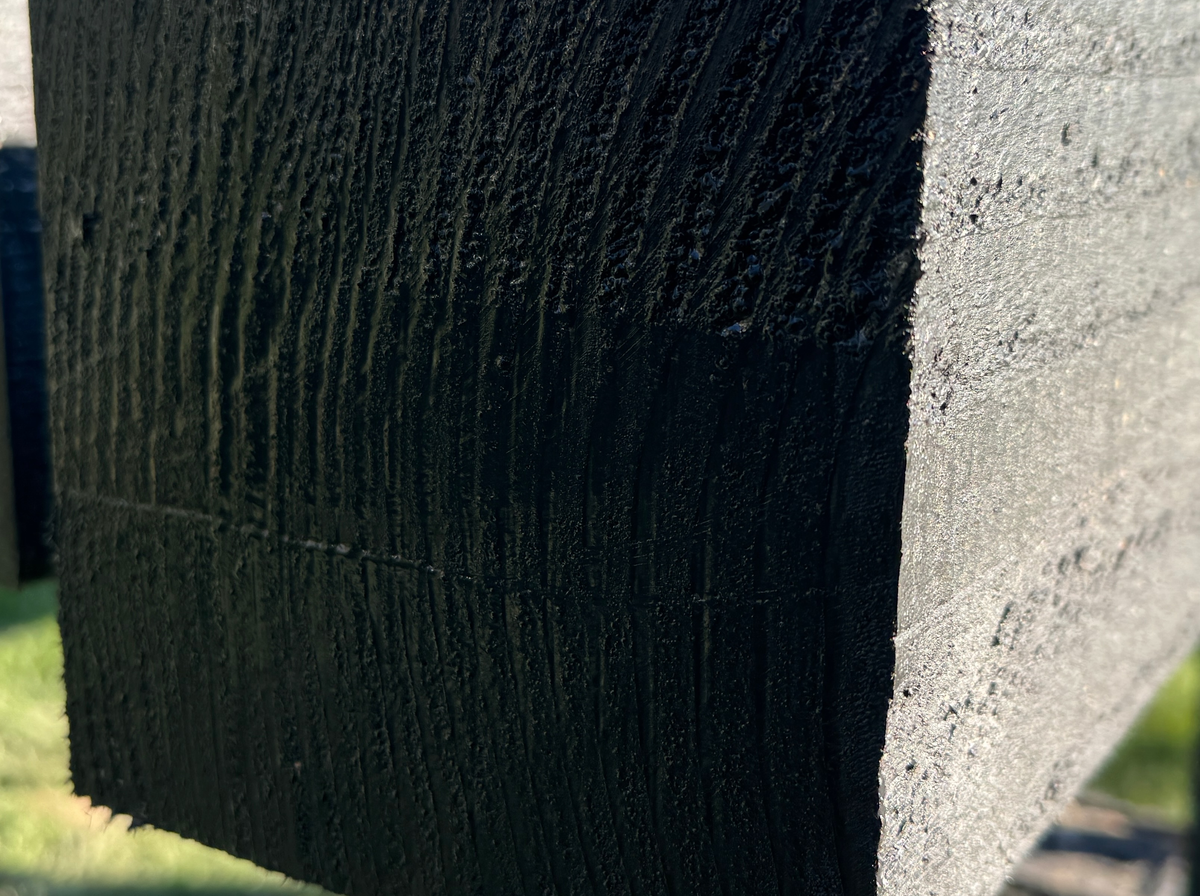
Why only one face cracked. How a timber was sawn out of the log decides the pattern. A plain-sawn face shrinks most and usually opens a single wide check. A quarter-sawn face shrinks less and tends toward several narrow ones. So a beam with one dramatic crack down one side and nothing on the other is not a beam with a flaw on one side. It is a beam showing you which way the grain runs.
Why the pattern varies more than the species does. Owners usually ask which wood checks least, and the answer is real but smaller than they expect. Douglas fir moves roughly half again as much as western red cedar as it dries, which is one of several honest trade-offs covered in our guide to the best wood for a Utah pergola.
- Where the pith sits. A timber sawn with the tree's centre inside it is called boxed heart, and it checks more than one cut to exclude the centre.
- How the face was sawn. Plain-sawn gives one wide check. Quarter-sawn gives several narrow ones. Short, broken checks clustered near the centre of a face are the same thing at a smaller scale.
- How big the piece is. A heavy section checks more visibly than a thin one, for reasons covered further down that are the opposite of a problem.
So two posts of the same species, from the same delivery, can look quite different a year in. They were cut from different parts of different logs.
Check or split? The one distinction that decides whether to worry
Almost every page written for homeowners on this topic uses "check," "crack," and "split" as though they were the same word. They are not, and the engineering definition is both sharper and more reassuring than the loose one.
A check is widest at the outer surface and gets narrower as it runs inward toward the pith, which is the original centre of the tree. A single check does not go past the pith. A split extends through the timber from one face to another.
There is one subtlety here that no consumer page seems to state, and it resolves a lot of unnecessary alarm: several separate checks can meet at the pith, and that is still not a split. A post with a crack on two opposite faces has not been cut in half. It has two checks that found the same centre.
| Runs | What it looks like | Cause | Worth a call? | |
|---|---|---|---|---|
| Seasoning check | Along the grain | Widest at the surface, narrowing inward, stopping at or before the centre | Normal drying | No |
| Split | Along the grain, face through face | Daylight through it, and the piece reads as two | Severe drying, or load | Yes |
| Cross-grain crack | Across the grain | Cuts the fibers instead of parting them | Not drying. Load, impact, or juvenile wood | Yes |
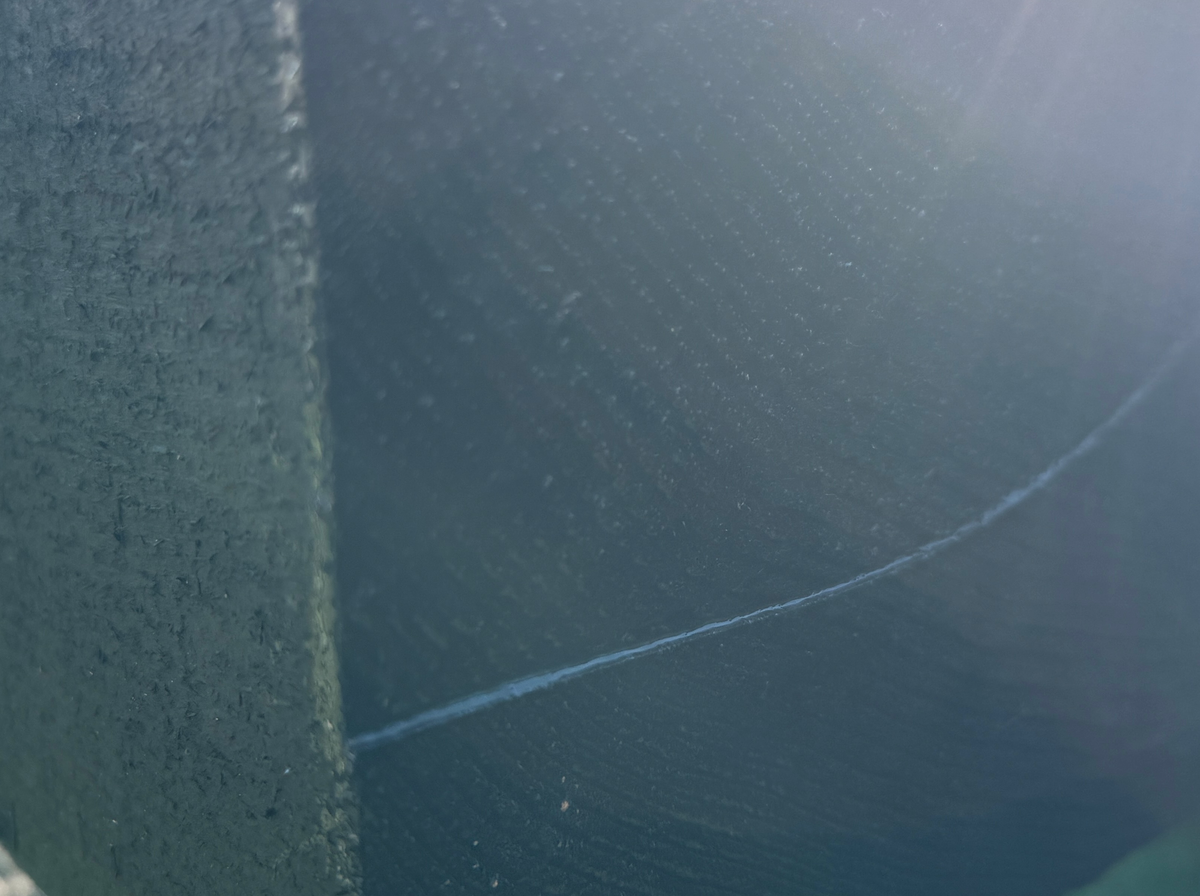
So the test an owner can run from the patio, without tools: does the crack follow the grain, and can you see through it? Along the grain and no daylight is a check. Across the grain, or daylight, is a different conversation. Our guide on how long a wood pergola really lasts walks through a five-minute spring soundness check that covers the rest of the structure.
Do checks weaken a pergola?
Here is the part that should settle the question, and it comes from structural engineers rather than from anyone selling pergolas.
For axial load, a check takes nothing away. The Timber Frame Engineering Council makes the point with arithmetic: an 8-inch by 10-inch post has 80 square inches of cross section without checks, and 80 square inches of cross section with them. No wood leaves the post. The fibers have parted, and they are all still there, all still carrying.
For shear, the margin was built in before your structure was designed. Shear is the one property a check can influence, and the people who publish the numbers knew that. The allowable shear values in the supplement to the National Design Specification for Wood Construction are set, in the bulletin's words, on "the conservative assumption of the most severe checks, shake, or splits possible, as if the timber were split through its full thickness for its full length."
The engineer who sized your beams was not working from a picture of a flawless timber. The published number already describes a timber split end to end, right through. Whatever you are looking at in your yard is better than the piece the design assumed.
Two supporting details for anyone who wants them. The visual grading standard, ASTM D245, carries a strength ratio of 0.5 as the maximum reduction applied for drying checks and splits in service, which is where that conservatism comes from. And shear is seldom the governing design value in a bending member anyway, so even the one property checks can touch is rarely the property deciding the beam.
The grading rules permit checks, and later checking is not a defect. New structural timbers are graded with limits on how deep a check may be.
| Member class | Grade | Maximum check depth |
|---|---|---|
| Beams and stringers, all species except Southern Pine | Select Structural, No. 1 | One quarter of the thickness |
| Posts and timbers, all species except Southern Pine | Select Structural, No. 1 | One half of the thickness |
| Southern Pine timbers | Select Structural, No. 1 | One third of the thickness |
| Southern Pine timbers | No. 2 | One half of the thickness |
| All timbers | No. 2 | No depth limit |
Those limits apply to green timbers at the mill, before installation, when nobody yet knows what moisture conditions the piece will live in. They are not a pass-or-fail test for a structure standing in your backyard. The bulletin is explicit that seasoning and checking after installation are not cause for re-grading the timber. Your pergola did not fail an inspection by drying out.
If anything, checks help a professional read the wood. Because they run parallel to the grain, a check is a useful indicator of slope of grain when someone grades a timber in place.
Stillbury builds in No. 1 Douglas fir, which is the second row of that table. We name the grade rather than an adjective because you can check it against the stamp on the delivered timber.
Why Utah pergolas check harder than the blogs prepare you for
Almost everything written about checking treats it as a universal, as though wood behaves the same in Ogden and in Mobile. It does not. Checking is a response to how far and how fast the local air moves moisture through wood, and that varies enormously across the country.
Start with the national answer. A timber installed green can take years to come into balance with the air around it, developing checks through the first several years of service, after which, in the bulletin's phrasing, the check is "essentially stable." Then comes the qualifier, which almost nobody quotes: that stability holds *unless the timber is subjected to significant changes in its moisture environment.*
In Utah, significant change is not an exception. It is the weather.
Federal outdoor equilibrium moisture content data, calculated from NOAA's 1981 to 2010 climate normals and republished by North Carolina State University's Wood Products Extension, gives Salt Lake City a July figure of 6.8 percent and a December figure of 14.9 percent.
| Location | Driest month | Wettest month | Annual swing |
|---|---|---|---|
| Salt Lake City, UT | 6.8% (July) | 14.9% (December) | 8.1 points |
| Seattle, WA | 12.0% | 16.9% | 4.9 points |
| Miami, FL | 12.2% | 14.4% | 2.2 points |
| New Orleans, LA | 13.7% | 15.0% | 1.3 points |
That 8.1-point annual swing is the 10th widest among the 260 United States locations in that table, and Utah's July reading is the 15th driest single month on it. A beam in a Provo backyard works through roughly six times the annual moisture swing of the same beam in New Orleans.
Which changes the honest Utah answer in a way worth saying plainly. Checks here do not simply form once and settle. They breathe. They open through a dry Wasatch Front July and close again through December, and they will do that every year the structure stands. An owner who panics each August is often looking at the same check they made peace with last spring.
This also explains a disappointment we would rather you hear from us. Stillbury's timbers arrive air-dried or green, so a share of the drying happens in your yard rather than before delivery. That is the trade for solid, heavy sections, and it means the first summer is the loudest one. We would rather write that down than let you find it in year one.
The same dryness that causes checking is why Utah is a good place to build in wood. It would be easy to read the table above as bad news. It is not. Decay is the failure mode that actually ends a wood structure, and decay needs sustained moisture. In a state averaging eleven to twelve inches of precipitation a year, wood spends most of its life well below the moisture content rot requires, which is why the real decay risk here is local and preventable rather than ambient: water trapped at a post base, sprinklers aimed at a post, debris holding moisture on a beam top.
So the trade runs like this. Utah's dryness is what makes checks open and close, and it is also why your structure is unlikely to rot. Checking is the cosmetic cost of a climate that is structurally kind to wood. A humid climate would hand you tighter-looking timbers and a much shorter argument about how long they last.
The same climate that does this to wood is the one that sets snow loads and freeze-thaw exposure, both covered in our Utah snow load guide. If you are in Provo or anywhere along the Wasatch Front, the figures above are your figures.
When a crack actually is a problem
Four situations are worth a phone call. They are uncommon, and naming them precisely is more useful than a blanket reassurance.
- A check near the end of a member, running in line with the bolts or screws. This is the one case the Timber Frame Engineering Council singles out. If a check near a member's end is wide and long enough to sit along the line of the connectors, those fasteners can lose holding capacity, and the connection should be evaluated. Note what this is: a connection question, not a beam question.
- A split running along the length. Lengthwise splits are typically *not* caused by drying. They more often come from excessive structural load, which makes a long split a symptom rather than a characteristic.
- A crack running across the grain. Drying cracks follow the fibers. A crack that cuts across them came from something else, usually load, impact, or a piece of juvenile wood from the fast-growing centre of a young tree.
- Standing water sitting in an upward-facing check on the top of a beam. This one is not a strength problem at all, and it is why it belongs on the list. Water held in an open check on a flat upper surface is a decay problem, which is a slower and more serious failure mode than anything checking does on its own.
Keep leaves and needles off the tops of beams, and the fourth one does not start. Everything about rot, post bases, and the self-inspection that catches it lives in our guide on how long a wood pergola really lasts.
Outside those four, the engineering position is unambiguous. The bulletin's own summary states that most checks do not affect the strength of the timber, that only rarely is consideration of shear stress warranted, and that the presence of seasoning checks typically requires no adjustment to the structure's calculated load resistance and no reinforcement or remedial action.
No adjustment. No remedial action. That is the standard talking, not a builder reassuring a customer.
Should you fill the cracks?
No. And this is the one place where we are flatly contradicting the most common advice you will find, which is to caulk or epoxy the checks and re-stain over the top.
The engineering guidance is that checks on exposed wood should not be filled with sealant. The reasoning follows directly from the Utah section above. A check that opens and closes through an 8-point annual moisture swing will work a rigid filler loose, and a filler stubborn enough to stay put will hold water inside the opening instead of letting it dry out. The cosmetic instinct and the long-term interest of the structure point in opposite directions.
Three things actually help:
- Keep the finish current, so the wood sheds water and takes UV on the finish rather than on the fibers. Different surfaces of the same structure wear at different rates, and the flat upper faces go first. Our best wood for a Utah pergola guide carries a surface-by-surface recoat calendar and a bead test you can run yourself.
- Keep debris off the flat upper surfaces, so nothing parks moisture in an open check.
- Leave the wood alone otherwise.
That is a shorter maintenance list than most owners expect, and it is the real one.
Can checking be prevented?
Not eliminated. Shaped, and only at the design and milling stage. Four levers exist, and all four involve a trade.
Cut the pith out. Timbers that contain the pith are called boxed heart, and they check more than timbers cut to exclude it. A timber specified free of heart center, or FOHC, avoids the pith entirely and checks noticeably less. It costs more and is harder to source in some sizes, which is why it is a specification rather than a default.
Stillbury specifies FOHC. That is the single biggest lever on this list, it is decided before anything arrives on a trailer, and it is a question worth asking any builder quoting you heavy sections. A boxed-heart 6x6 and an FOHC 6x6 cost different money and age differently, and only one of them has the tree's centre running down the middle of it.
Kerf the timber. A kerf is a narrow saw cut run lengthwise into the piece, which relieves the drying stress on purpose and decides *where* the check forms, usually on a face nobody will ever look at. It may slightly reduce the strength of the piece, and on preservative-treated wood it has to be cut before treatment, because a kerf can run deeper than the preservative penetrates.
Seal the end grain, which is where drying runs fastest. Stillbury does not kerf. It seals cut ends instead, and the reason comes straight out of the mechanism at the top of this page: end grain is open grain, water leaves a cut end far faster than it leaves a face, and that steep gradient at the ends is why end checks appear within days. Slow the fastest-drying surface down and fewer checks start there in the first place.
The detail worth knowing is *when* it happens. Every timber gets stained before it reaches your yard, but the cuts made on site open fresh end grain that the first coat never touched. So after a beam is cut to length and the slot for its knife plate is drilled, the exposed end gets stained again before the piece goes up. It is a few minutes per end, at the one moment the wood is most willing to lose water quickly, and it is the kind of step that is invisible in a finished photograph.
Kerfing and end-sealing are both check control, but they work differently and it is worth being precise: a kerf *redirects* a check to a face you chose, while sealing the ends *reduces how many start* at the fastest-drying surface. Neither one stops solid wood from moving.
Dry it differently. Timbers dried in a radio-frequency kiln develop fewer checks, because the moisture gradient across the section stays more uniform as the piece dries. Air drying, which is how most structural timber reaches a job site, produces a steeper gradient and more checking.
Understand what section size does, because most owners have this one backwards. A heavy timber checks more visibly than a thin one for the simple reason that there is more wood releasing more moisture over a larger face. The same percentage of movement that reads as a surface check down a 4x12 beam will instead work a joint loose on a 4x4 post. One of those is cosmetic and one is structural, and the heavier section is the one that stays sound.
The structures that check most are often the ones built to last longest. A pergola framed in thin catalog lumber will show you fewer checks and more sag.
Why a dark stain makes checks look worse
Here is something nobody in this trade seems to tell customers, and it changes what a worried owner is actually seeing.
Applying a dark stain to green timbers makes checks appear more pronounced. The Timber Frame Engineering Council notes it directly. The mechanism is not complicated: a check opens to reveal unfinished wood inside, and the greater the contrast between the stained face and the raw interior, the more the eye snags on every opening.
Stillbury's finishes run from natural Douglas fir through Slate, Cordovan Brown, and Espresso. If you chose one of the dark ones, this is worth knowing. The checks are not worse. The contrast is. The same structure in natural fir, which dries to a muted warm tan rather than anything honey-gold, would show you the same openings and you would notice far fewer of them.
Natural fir hides checking best. A dark stain shows it most. Neither is wrong, and it is a trade worth understanding before the decision gets made rather than after, since the finish is chosen during design. If you are still at that stage, a free 3D design and quote is where finish and section size get decided together, which are the two choices that determine how much checking you will ever notice.
Is checking covered by a pergola warranty?
Checking is excluded from most wood structure warranties, including Stillbury's. Stillbury warranties its structures for three years, covering workmanship, and the warranty excludes sap and checking.
We would rather explain that exclusion than bury it, because this is the page where an owner will go looking for it.
A warranty that promised no checking would be a warranty against wood being wood. Any company offering one is either confused about the material or does not intend to honour the clause, and neither is a company you want holding your paperwork. The exclusion is not a loophole. It is the sentence that tells you the rest of the document was written by someone who understood what they were selling.
What *is* worth comparing between builders is the other side of it: what the warranty does cover, how long it runs, and whether it exists in writing at all. Those questions, along with licensing and insurance, are covered in our guide on how to choose a pergola builder in Utah.
One honest note for completeness. The big-box kit warranties covered in are pergola kits any good exclude natural warping and checking too. This is not a custom-versus-kit difference. It is a solid-wood fact, and every honest wood warranty in the industry says the same thing.
What we can and cannot show you about how this settles
Being straight about where Stillbury sits. No Stillbury structure has stood through enough Utah summers to show you how its checking finally settled. The company launched in 2026, and the pergolas built this year are going through their first dry season now. Any company our age claiming its structures have proven themselves over a decade would be telling you something that cannot be true.
What we can tell you is that the two people who run Stillbury have been working timber a lot longer than the company has existed. One of them has more than ten years at it. The other has more than twenty.
That is where the confidence on this page comes from. Not from a Stillbury pergola that has weathered ten winters, but from decades of watching what heavy wood does: checking in the places it shows up, at the time of year it shows up, to the degree it shows up. Expecting it is why FOHC is specified and why cut ends get sealed on site.
How long a company has existed and how long its people have worked the material are two different questions, and only the second one tells you whether they know what your wood is about to do.
A structure that checks is a structure made of wood
The crack follows the grain, it takes away no load-carrying wood, the engineer who sized the beam assumed a worse piece than the one you own, and in Utah it will open and close with the seasons for as long as the structure stands.
The two decisions that determine how much checking you ever notice both get made before anything is built: how heavy the sections are, and how dark the finish is. If you are at that stage rather than this one, a free 3D design and quote is where both get settled, at no cost and with the structure drawn on your own yard.
And if your crack is one of the four worth a call, call somebody. That is a short list on purpose.