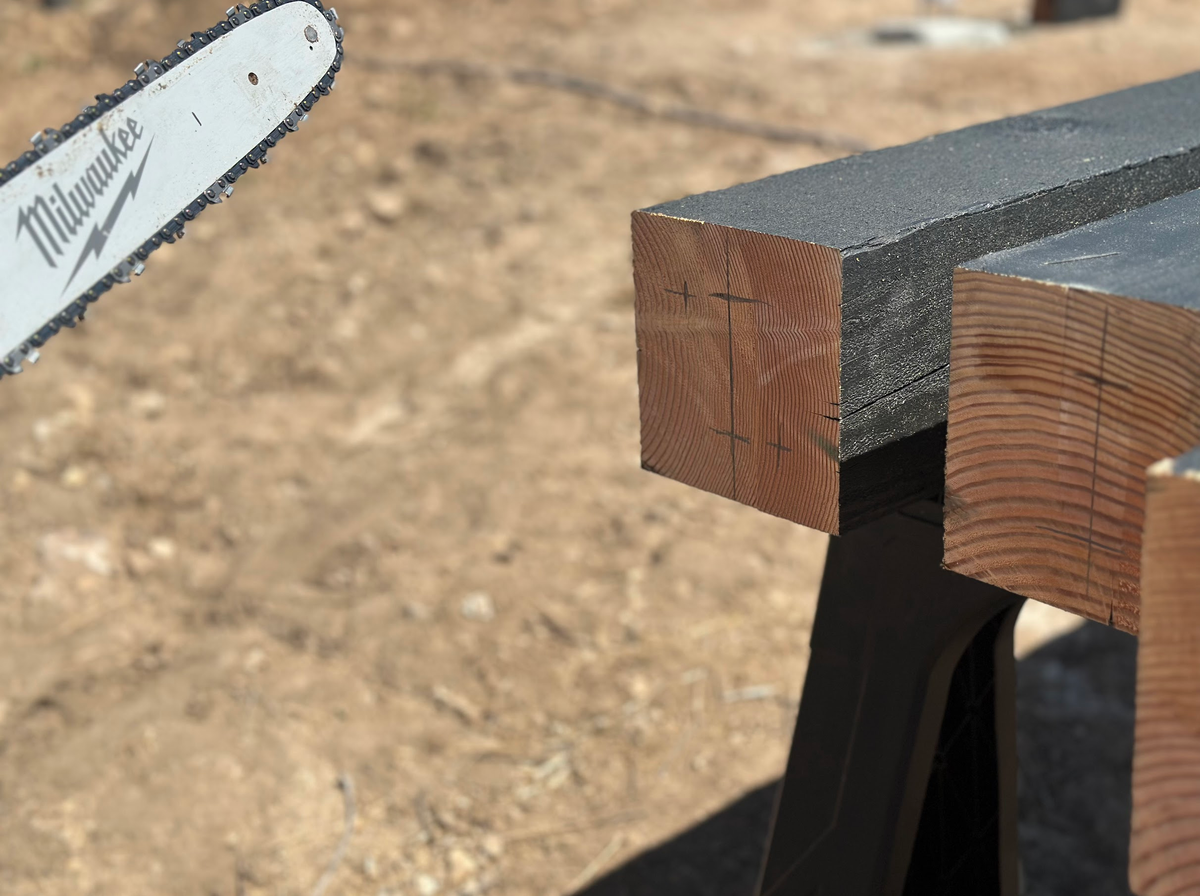
Cedar heartwood resists decay better than Douglas fir, and every published pergola-wood chart is right about that. In Utah it is close to the least useful thing you can know. Decay needs sustained moisture, this state gets about eleven inches of rain a year, and the two properties that actually decide how a Utah pergola looks in year ten are not on the chart at all.
Key takeaways
- This guide covers material selection for a Utah pergola: which species, what grade, what section, kiln-dried or green, what finish, and what the metal parts should be. For how long a pergola lasts and why they fail, see how long a wood pergola lasts. For prices, see what a custom pergola costs in Utah Valley. For wood against metal as a category choice, see wood vs. aluminum.
- Species charts rank natural decay resistance, which is a heartwood property and the one Utah's climate is least likely to test.
- The properties that do vary between these species are stiffness and dimensional movement, and no popular chart lists either.
- Douglas fir moves more than cedar. USDA Forest Products Laboratory shrinkage data puts Douglas fir at roughly half again as much movement as western red cedar.
- Section size decides whether that movement matters. The same shrinkage reads as a surface check on a 4x12 beam and racks a bracket joint on a 4x4 post.
- Pressure-treated lumber is rated by use category, printed on the end tag. Above-ground parts are UC3B; hard-to-replace posts and beams can call for UC4A. Ask for KDAT if you want treated lumber that does not shrink after install.
- The popular treated post with a cedar frame above solves a problem that only exists if the post is buried.
- Utah's high-elevation sun attacks the finish, not the structure. Ultraviolet light reaches roughly 75 micrometers into wood.
- The honest short answer: No. 1 Douglas fir in a heavy section, held clear of the concrete, with a penetrating finish you recoat.
What is the best wood for a pergola in Utah?
The best wood for a pergola in Utah is Douglas fir in a heavy structural section, set on a metal base that holds it clear of the footing, finished with a penetrating stain. Western red cedar is the better choice if a lighter, softer look matters more than stiffness. Both work. Neither one works if the post stands in a puddle.
Start with the concession, because the charts are not lying. Cedar and redwood heartwood carry extractives that resist decay fungi, and Douglas fir heartwood does not carry them in the same quantity. If you set three untreated posts in wet soil, the cedar one outlasts the fir one. That is a real property of the wood and nobody should pretend otherwise.
Cedar is also the answer almost everyone gives. We asked the five AI assistants Utah homeowners actually use the same five questions about pergola wood in October 2026, and all five led with western red cedar. All five also gave the same second reason, which is the interesting part: not that cedar resists rot, but that cedar moves less. "Dimensionally stable so it doesn't warp, splinter, or crack," as one of them put it. That instinct is correct, and not one of the pages any of them cited puts a number on it.
The question is whether your pergola is the experiment that tests decay at all.
Decay fungi need wood held at sustained high moisture content. The USDA Forest Products Laboratory puts the working threshold near 28 to 30 percent. Utah averages roughly eleven to twelve inches of precipitation a year, and building code has required for decades that a wood column exposed to weather sit on a pier or metal pedestal clear of the concrete rather than on it. Put those two facts together and the open-air parts of a Utah pergola never get near the decay threshold. Our guide to why pergolas fail walks the whole mechanism, and the short version is that pergolas rot at the post base or they do not rot.
So the property every chart ranks is the property Utah is least likely to test. Something else is going to determine what your pergola looks like in ten years.
Why is cedar always ranked first for a pergola?
Cedar is ranked first because the standard chart ranks natural decay resistance, and cedar heartwood wins that category outright. The chart leaves out the two properties that matter more in a dry climate.
The standard chart has three or four columns and they all measure roughly the same thing. A page will rank seven species by rot resistance, insect resistance, cost, and "appearance," then hand you a winner. Two columns that matter are missing every time.
| What the chart measures | What it tells you in Utah |
|---|---|
| Natural decay resistance | Little, in open air with a correct post base |
| Insect resistance | Little; Utah's dry climate is not a termite corridor |
| Cost per board foot | Material is a fraction of an installed price |
| Appearance | Only until a finish goes on it |
| Stiffness, which resists sag over decades | Not on the chart |
| Dimensional movement, which decides checking and whether joints stay tight | Not on the chart |
Stiffness is covered on our durability guide, which carries the American Wood Council design values for the comparison. Movement is the one nobody writes about, so it gets the next two sections.
Douglas fir vs cedar vs redwood vs treated pine vs hardwood
Five materials are genuinely in play for a Utah pergola. Here is each one with the property that actually recommends it and the property that disqualifies it.
| Factor | Western red cedar | Douglas fir | Redwood | Pressure-treated pine | Tropical hardwood |
|---|---|---|---|---|---|
| Heartwood decay resistance | High | Moderate | High | Chemical, through the section | Very high |
| Stiffness | Lower | Highest of the five | Lower | Moderate | Very high |
| Dimensional movement as it dries | Lower | Roughly half again as much as cedar | Low | Varies with treatment and moisture | Low, but very dense |
| What retail stock usually is | Often second-growth, sapwood-heavy | Consistently graded structural stock | Expensive, supply-constrained | Sold wet; shrinks after install | Import, long lead time |
| Available in heavy sections in Utah | Limited | Readily | Rarely | Limited above 6x6 | Special order |
| Holds a cut joint | Softer, crushes under a tight fit | Dense enough to hold a shoulder | Soft | Soft, and wet when cut | Excellent, hard on tools |
| Natural color | Pink to red-brown, fades to silver | Light, muted warm tan | Deep red | Green or tan cast from the treatment | Dark brown to olive |
| Honest downside | Costs more, moves less, sags sooner | Checks more than cedar | Price, sourcing | The end tag question below | Price, weight, movement of its own |
| Best for | A light structure where look leads | A heavy structure meant to stay flat | A small feature where budget is open | A utility structure or a deck frame | A screen or a detail, rarely a frame |
Stillbury builds in Douglas fir, and the reason is narrower than "it is the best wood." It is the stiffest of the five, it comes in heavy structural sections from Utah suppliers without a special order, and it is dense enough to hold a cut joint under load rather than crushing at the shoulder. Fresh-milled fir also finishes to a muted warm tan rather than a honey gold, which is the look of a building instead of a kit.
What Douglas fir is not is the naturally rot-proof choice. We would rather write that down here than have you find it on a chart somewhere and wonder why we left it out.
Stillbury will build in cedar or redwood on request. It goes out as a custom bid rather than off the standard list, and the available section sizes differ from what we stock in fir, so the design gets drawn to what can actually be sourced in that species. If a species matters to you more than the standard build, ask for it at the design stage rather than after the drawing is done.
Does Douglas fir move more than cedar?
Yes. Douglas fir shrinks and swells roughly half again as much as western red cedar, and this is the fact the charts leave out.
USDA Forest Products Laboratory shrinkage data puts Douglas fir at roughly half again as much movement as western red cedar, measured from green to oven-dry. Across the face of a wide beam that difference is visible. It shows up as checks, as slight cupping on a flat upper surface, and as joints that want to open if nothing holds them closed.
We are publishing the fact that argues against our own species because it is true and because it leads somewhere useful. The useful part is not which species moves less. It is what the movement does when it happens, and that depends on something the species chart never asks about.
Why does a pergola crack, and does the size of the wood change it?
A pergola cracks because wood shrinks as it dries, and the size of the wood decides whether that shrinkage is cosmetic or structural. A percentage of shrinkage does different damage depending on what it is shrinking. The same movement that reads as a cosmetic check down the face of a 4x12 beam is what opens a bracket joint on a 4x4 post.
Here is the mechanism. Wood dries from the surface inward. The surface shrinks while the core has not yet moved, the core restrains it, and the stress relieves itself as a split along the grain. On a heavy section the split runs down the middle of a lot of remaining wood and takes almost nothing structural with it. On a light section there is not much remaining wood, and the split runs through the zone where a lag bolt or a bracket plate is trying to hold.
Put it in dimensions. A 12x20 pergola framed in 4x12 beams on heavy posts carries exactly the same percentage of movement as a 12x20 framed in 2x8 beams on 4x4 posts. The two will look nothing alike in year five. The first one checks. The second one racks.
Then the joint type compounds it. A bracket joint depends on a fastener staying tight in a hole. Wood that shrinks away from a bolt leaves the bolt loose, and a loose bolt in a four-by-four is a connection that moves in the wind. A cut joint works the opposite way. A mortise, a tenon and a peg hold by geometry, so the parts can move seasonally and stay engaged. This is the whole argument for heavy-section joinery over catalog lumber and hardware, and it has nothing to do with looking old-fashioned.
A practical note on section sizes. Lumber sold as "4x12" is usually not twelve inches. Nominal dimensions are planed down, so a nominal 4x12 measures about three and a half by eleven and a quarter. Stillbury's beams are true to size, meaning a 4x12 measures four by twelve. When you compare two quotes, ask each builder whether the numbers in the proposal are nominal or actual, because a half inch on every face is a real difference in both stiffness and price. Post placement and the practical beam span limit are a sizing decision rather than a material one, and our pergola size guide covers them.
Is pressure-treated lumber good for a pergola?
Pressure-treated pine is fine for the parts of a pergola it is rated for, and the rating is printed on the end tag. Most buyers never look at it.
The American Wood Protection Association sorts treated wood into use categories. UC3B covers exterior wood above ground that does not touch the soil, and treated-wood industry guidance lists pergolas under it. That is the right category for rafters, slats and cross-members. AWPA's own residential guidance then adds a caveat that nobody passes along: components exposed to ground-contact hazards "due to climate, artificial or natural processes or construction" may need ground-contact preservation, and it names joists and beams that are difficult to replace and critical to the structure. On a pergola that points at the posts and the main beams, which argues for UC4A in those positions.
So the question to ask is not "is it treated." It is "what use category is on the tag, and for which members."
The second treated-lumber fact is about water, not chemistry. Treated lumber is commonly sold wet, straight from the treatment cylinder. It shrinks after it is installed. A treated pergola that looked tight in June can show open joints by October, and the cause is moisture leaving the wood rather than bad workmanship.
There is a fix for that, and it has a name worth knowing: KDAT, kiln-dried after treatment. KDAT stock has had the treatment water driven back out, so it arrives at a stable moisture content and stays close to it. It costs more and Utah yards do not always stock it. Asking for it by name is the difference between a treated structure that stays tight and one that opens up in its first season.
Treated pine is also soft, it is wet when it is cut, and the green or tan cast from the treatment sits under any stain you put over it. For a utility structure that is a fair trade. For a structure you look at from the kitchen window, it is the compromise you notice first.
On relative cost, without quoting an installed price: cedar generally runs somewhere around two to three times the material cost of treated pine, and Douglas fir sits between them. Material is only a fraction of what an installed structure costs, which is why a species upgrade changes a quote by less than people expect. Our cost guide carries the actual Utah ranges and what moves them.
Should the posts be pressure-treated with cedar above?
The treated-post-and-cedar-frame combination is the most common recommendation on this topic and it rests on an assumption that a correctly built pergola removes.
The logic goes: the post base is where rot happens, treated lumber resists rot, so put treated lumber at the base and the good-looking wood above it. Three of the five AI assistants we asked recommended exactly that, and one of them managed to recommend setting the posts in concrete and on a standoff base inside the same paragraph. Those are opposite instructions, and the contradiction is the tell.
A post set in concrete or in soil needs rot resistance because it is going to be wet. A post standing on a metal base above the footing does not get wet in the first place, so there is nothing for the treatment to protect against. The treated post solves a problem created by burying the post. Hold the post clear of the concrete and the problem does not exist, which is why building code has required that standoff for decades. Our durability guide has the code citation and the failure mechanism.
The combination also carries costs the recommendation does not mention. Two species means two rates of movement meeting at the most heavily loaded joint in the structure. It means a treated post that was sold wet shrinking away from a connection that cedar above it is not shrinking away from. And it means either a visible change of color and grain at the post-to-beam line, or a cedar or PVC sleeve wrapped around the post to hide it, which is one more surface to maintain and one more cavity for water to sit in.
Use a treated post if the post is going in the ground. If it is going on a standoff base, build the whole frame from one species and spend the difference on the base detail instead.
One more material the species charts skip. Thermally modified wood is ordinary softwood baked at high temperature, which drives out the moisture and the sugars decay fungi feed on. It is genuinely more stable and more decay-resistant than the wood it started as, it carries no chemicals, and it is a real option for a pergola. It is also a special order in Utah, it is more brittle than untreated stock, and it is not something Stillbury builds in. It belongs on this page because it is a fair answer that nobody comparing cedar to fir ever mentions.
Should a pergola be built from kiln-dried or green wood?
Neither one stays at the moisture content it arrived at. Outdoor wood equalizes with the air around it, so a kiln-dried timber driven down to seven or eight percent will take moisture back on once it is standing in a yard, and a green timber will keep giving moisture up for years.
Stillbury's timbers arrive air-dried or green, which means some of the drying happens in your yard. We would rather say that plainly than let you discover it from the first check. It is also why the next two paragraphs exist, and why our warranty names checking as excluded instead of pretending it will not happen.
The honest way to frame the choice is where the drying happens: in your yard or before delivery. Green timber installed wet does most of its shrinking in place, which is where checking and joint movement come from. Material that has already come down toward outdoor equilibrium does less of that after install, though it will still move with the seasons for as long as it stands.
Checking is worth naming plainly because it alarms people. A check is a split along the grain from uneven drying, and on a heavy section it is a surface characteristic rather than a defect. Stillbury's three-year warranty covers structural workmanship and structural integrity, and it excludes sap and moderate checking, because both are what solid wood does. A warranty that promised otherwise would be a promise about physics.
What grade should a pergola be built from, and how do you ask for it?
Grade is a strength classification stamped on structural lumber, and it is the specification most quotes never mention. For Douglas fir the relevant grades run Select Structural, No. 1, and No. 2, in descending order of allowable design values. A beam in No. 2 and a beam in No. 1 at the same nominal size are not the same beam.
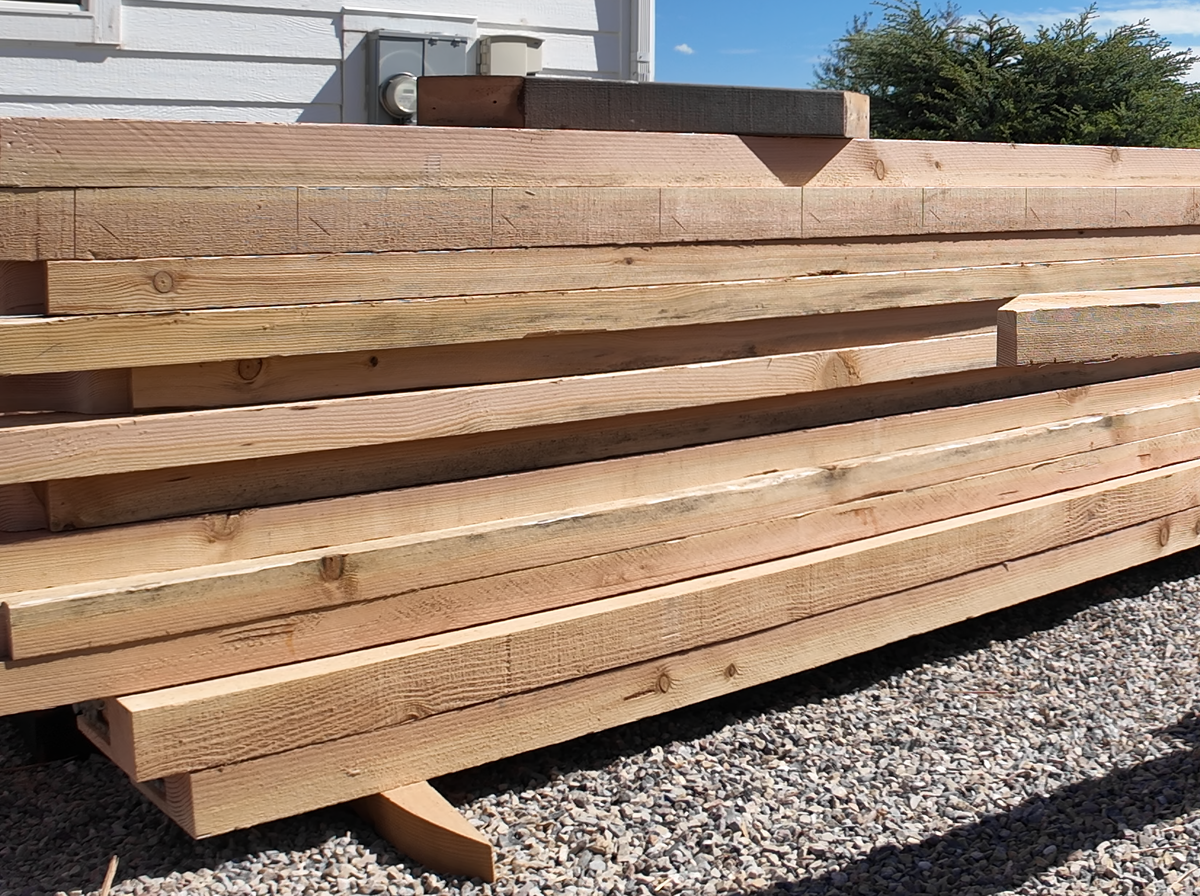
Stillbury builds in No. 1 Douglas fir. That is one step below the top grade and well above what a kit or a big-box rack carries, and the honest reason to tell you the number rather than an adjective is that you can check it against the grade stamp on the delivered timber.
Three things to ask about, none of which require you to know wood science:
- What species and grade, in writing. A proposal that says "cedar-tone treated lumber" has told you about a color, not a material.
- Nominal or actual dimensions. Covered above, and the cheapest half inch anyone ever saved.
- Surface. Rough-sawn carries mill marks and the small blemishes that come with a sawn face. S4S is planed smooth on four sides. Rough-sawn is not a defect or a lower grade, it is a look, and Stillbury's structures are rough-sawn. If you want glass-smooth timber, that is a different build and worth saying up front.
What does the Utah sun actually damage?
Utah's sun damages the finish, not the structure. Ultraviolet light penetrates roughly 75 micrometers into a wood surface, and lignin, the compound that binds wood fibers together, absorbs most of it. Published reviews of the wood-photodegradation literature put lignin at 80 to 95 percent of wood's total UV absorption, against 5 to 20 percent for the carbohydrates and about 2 percent for extractives. Lignin breaks down first, which leaves a thin surface layer of loose cellulose fibers. That layer is what weathers away and what turns an unfinished structure silver-grey.
Seventy-five micrometers is about the thickness of a sheet of paper. Nothing structural lives there.
Elevation does intensify the exposure, and the published estimates disagree enough that a single number would be dishonest. Environment Canada's UV calculator uses about four percent more UV per thousand feet of elevation, and measurements by Rigel and colleagues across Vail, Orlando and New York support something closer to eight to ten percent. A 2025 study at Chilean high-altitude sites found 5.7 to 11.6 percent per thousand meters. Utah Valley sits near 4,500 feet, so the fair statement is that a pergola here takes meaningfully more UV than the same pergola at sea level, somewhere in that range, and the consequence lands on the finish.
Which reverses the usual framing. "Best wood" is a species question in every article written about it. In Utah it is mostly a finish question with a species attached.
How often does a pergola need to be stained in Utah?
Plan on recoating a Utah pergola every two to three years, sooner on any surface in full afternoon sun, and washing it once a year. The calendar is a prompt rather than a rule, and the test that settles it takes ten seconds: flick water onto a top-facing surface, and if it soaks in instead of beading, the finish is done.
Worth saying plainly, because the best-regarded local page on this topic declines to give an interval at all and routes the question to a site visit. That is defensible, and it leaves a homeowner with nothing to plan around. Here is a number and the reasoning behind it, and a site visit will still beat both.
The interval depends on the finish type more than the wood. A penetrating stain soaks in and wears thin, so recoating means cleaning the surface and applying more. A film finish sits on top and fails by peeling, so recoating means stripping the old film off first. Every Stillbury finish is a penetrating stain for that reason, and our stain colors page shows how each one looks and ages. Salt Lake Valley painting contractors publish intervals in the same range, generally one to three years for a transparent stain and two to five for a solid one, with horizontal surfaces needing attention first. Those are contractor recommendations rather than test data, and they match what the physics predicts.
| Surface | Why it fails first | Typical attention |
|---|---|---|
| Beam and rafter top faces | Hold water, take direct sun all day | First to need a recoat |
| West and south faces of posts | Afternoon UV load | Next |
| Undersides and shaded faces | Little UV, little standing water | Last, often much later |
| Post bases | Irrigation spray, splash | Inspect yearly, finish is secondary to drainage |
You can also decline the whole calendar. An unfinished Douglas fir structure drifts to a soft silver-grey over a few seasons, the way a barn does, and it loses nothing structural doing it. That is a legitimate choice and some people prefer it. What it is not is a lower-maintenance structure, because the post bases and the drainage still want an annual look.
One thing we cannot show you, and would rather say than have you notice. We do not have a photograph of a Stillbury structure at three years, because no Stillbury structure is three years old yet. Every claim in this section is physics and finish chemistry rather than a build we can point at, and anyone who shows you a weathered structure as evidence of their own finish schedule should be asked when it was built.
What you can check without trusting us at all: the finish is a penetrating stain rather than a film, which means its failure mode is thinning rather than peeling, and that is visible on any penetrating-stained wood you can find. The bead test above works on a neighbour's pergola as well as your own. And the three-year warranty is a written term with its exclusions printed, which is a promise you can hold us to rather than a photograph you have to take our word for. The first genuinely weathered Stillbury finish will go on this page when there is one.
What should the brackets and post bases be made of?
The metal is part of the answer to "what should it be built from," and no pergola article treats it that way. Two connections carry the structure and they are made of different metals for different reasons.
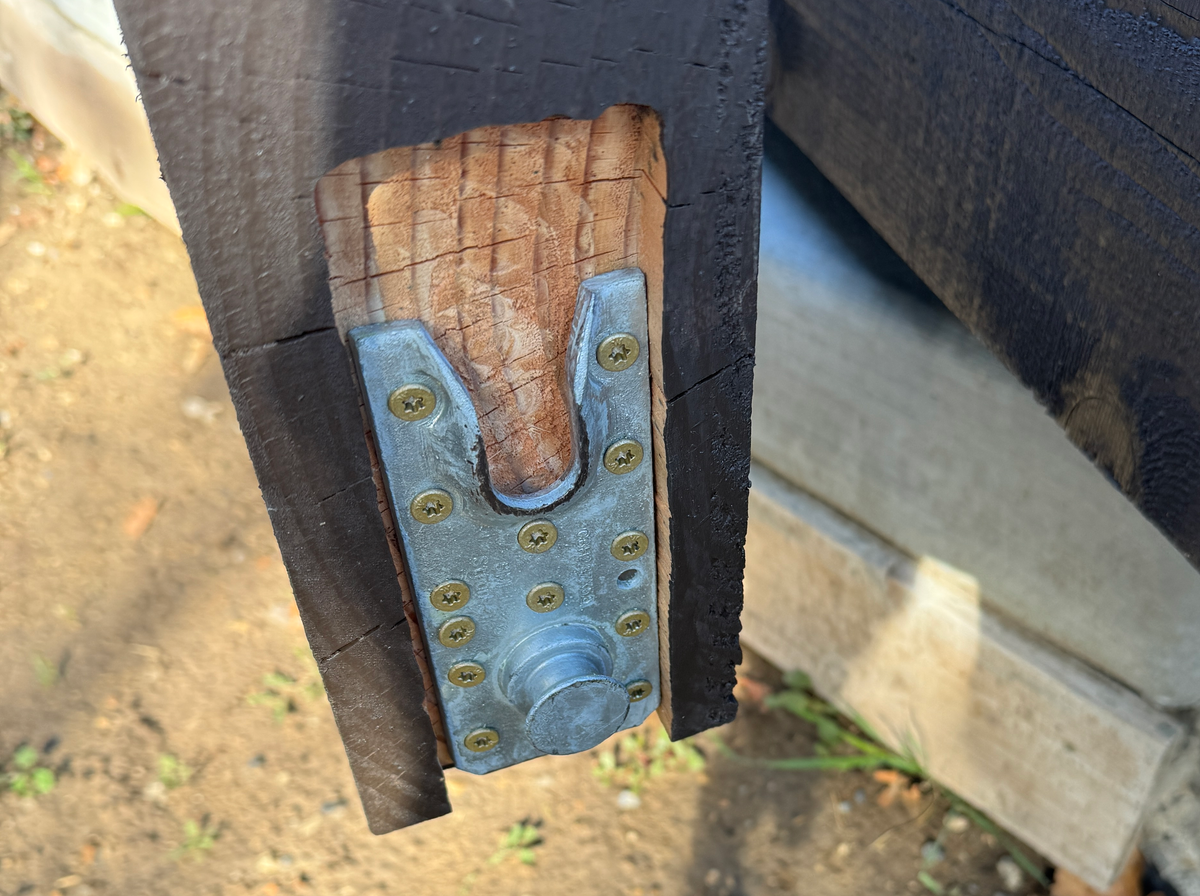
- Post to beam: galvanized steel. The zinc coating is the corrosion protection, and steel is what carries the load at that joint.
- Post to footing: aluminum knife plates. Stillbury uses a rust- and corrosion-resistant aluminum at the base connection, which does not shed rust stains down a post the way a corroding steel base does.
- The gap. Every post sits on a quarter-inch standoff above the footing. That gap exists so the end grain at the bottom of the post can drain and dry rather than wick water upward, which is the single most common cause of pergola failure. The durability guide explains the mechanism and the code behind it.
Rust streaks on a post are not cosmetic news. They say water is sitting at a fastener, which means it is also sitting in the wood around the fastener.
Does a pergola kit use the same wood as a custom build?
A kit can use the same species as a custom build and still be a different structure, because the species is only one of the material decisions. A pergola kit hands you the species and leaves you the geometry. You choose the closest catalog size to your patio, and the structure fits the catalog rather than the house. That is the real trade, and it is separate from whether the wood is any good. Our guide to pergola kits covers what actually ships in one.
A custom build inverts it. The span, the post placement, the beam section and the finish are all decisions about your yard, which is also why they are harder to picture from a quote. Stillbury's answer to that is a free 3D design: your structure, drawn on your patio, in the finish you picked, before you pay anything. If you are deciding between two species or two finishes, seeing both rendered on your own house settles it faster than any chart on this page.
What should I ask a pergola builder about the wood?
Ask for the species and grade in writing, whether the dimensions are nominal or actual, and what the post sits on. Those three answers predict more than any species chart. The full list works on any builder, including us. None of it requires wood knowledge, and every answer is checkable.
- What species and grade, written into the proposal?
- Are the dimensions nominal or actual?
- Kiln-dried, air-dried, or green at delivery?
- What does the post sit on, and is there a gap above the footing?
- Cut joints or bracket hardware at the beam connections?
- Penetrating stain or film finish, and what is the recoat interval?
- What metal is at the base connection?
- What does the warranty cover, and does it exclude checking?
A builder who answers all eight in a minute has thought about the structure. A builder who answers in adjectives has thought about the sale.
What should a Utah pergola be built from?
No. 1 Douglas fir, in a heavy section, set clear of the concrete on a metal base, joined with cut joints rather than fastener-dependent hardware, and finished with a penetrating stain you plan to recoat. Cedar if the look matters more than the stiffness. Treated pine if it is a utility structure and you read the end tag.
What it should not be built from is the top row of a species chart. That chart ranks the one property Utah's climate is least likely to test, and leaves out the two that decide how the structure sits in your yard a decade from now.
If you want to see the species and the finish on your own patio before you commit to either, the 3D design and quote are free, and nothing about it obligates you to build.