Choose aluminum if you want the least upkeep and the lowest price for a simple lattice cover, and you like a flat, modern profile. Choose wood if you want a structure that stays comfortable to touch, fits your patio exactly, and reads as part of the house. This guide gives both sides with numbers, from a builder who works in Douglas fir.
Key takeaways
- This guide compares wood and aluminum for a backyard pergola along the Wasatch Front. It is written by a wood builder, and it makes the aluminum case fairly.
- Aluminum conducts heat roughly 1,500 times faster than softwood (216 vs 0.10 to 0.14 W/m·K, USDA Forest Products Laboratory). That is why a sun-struck aluminum rail feels hotter than a wood rail at the same temperature.
- An installed Alumawood lattice cover runs about $18 to $22 per square foot. A 12x16 custom Douglas fir pergola in Utah Valley runs about $15,000 to $23,000. Louvered aluminum systems cost as much as or more than custom wood.
- Aluminum never rots and never needs stain. Its weak point is the coating. Ask for the AAMA spec (2604 or 2605), because a 2603 finish is tested to one year of sun.
- A 16-foot aluminum beam grows about a quarter inch between a January morning and a July afternoon. Wood along the grain moves about a twentieth of that. That movement is the afternoon click.
- Neither material is snow-proof. Ask any seller for the rated pounds per square foot and compare it to your city's number.
- The custom-versus-catalog difference is bigger than the material difference. Aluminum ships in catalog sizes. A designed pergola is drawn to your patio, and you can see it in 3D before paying anything.
Wood or aluminum pergola: the short answer by what you care about
Aluminum wins on maintenance, on the price of a basic lattice cover, and on never rotting. Wood wins on how it feels in the sun, how it fits a patio, and how it looks on most Utah homes. The table below is the whole decision in one place, and the rest of the guide explains each row.
| What you care about | Wood (Douglas fir, heavy timber) | Aluminum (powder-coated extrusion) | Edge |
|---|---|---|---|
| Touch in full sun | Warm; low conductivity, so it does not pull heat from your hand | Same surface temperature, 1,500x the conductivity; a dark frame can feel too hot to hold | Wood |
| Upkeep | A penetrating stain recoat every few years, sooner in full sun | Rinse twice a year; no stain ever | Aluminum |
| Price, simple lattice cover | Custom wood starts around $9,000 for a 10x10 | About $18 to $22 per square foot installed | Aluminum |
| Price, louvered or solid roof | A custom wood pavilion | A louvered aluminum system costs about the same or more | Even |
| Rot and insects | Possible if the post base is done wrong; decided by detailing, not species | Never | Aluminum |
| Fading | The finish weathers and gets recoated | The coating chalks and fades; cannot be recoated in place to the original spec | Depends on the coating spec |
| Noise | Checking sounds the first summer as it dries | Expansion clicks on hot afternoons; rain drums on solid or louvered roofs | Even |
| Dents and repairs | A gouge in an 8x8 post gets planed and refinished | A dent in an extrusion means a replacement member, if the part still exists | Wood |
| Fire | Combustible; heavy sections char slowly | Non-combustible | Aluminum |
| Fit to your patio | Drawn to your space, any span, any post placement | Catalog sizes, sometimes a custom order at a premium | Wood |
| Look on a traditional or craftsman home | Reads as part of the house | Reads as a frame or a carport | Wood |
| Look on a flat-roofed modern home | Straight-brace styles work, but a black metal frame is the native look | Right at home | Aluminum |
| Snow | Open slats pass snow; solid roofs need engineering | Same rule; kits carry a rated psf that you must read | Even |
That is a fair scorecard, and it gives aluminum five rows outright. If your priorities are the aluminum rows, buy aluminum. The rest of this guide exists because most of those rows have a number behind them, and the number changes the decision more often than the adjective does.
Do aluminum pergolas get hot?
Yes. An aluminum pergola in direct Utah sun gets hot to the touch, and the reason has more to do with how fast aluminum moves heat than with how hot its surface gets. Aluminum sellers tell you the surface reflects sunlight and cools quickly once the sun moves. Both statements are true. They are also not the answer to the question your hand is asking.
Your hand does not measure temperature. It measures how fast heat flows into it. That rate is set by a material property called thermal conductivity, and the gap between wood and aluminum is enormous. The USDA Forest Products Laboratory's Wood Handbook puts structural softwood lumber at 0.10 to 0.14 W/m·K and aluminum at 216. Steel is 45. Concrete is 0.9. Wood sits next to insulation on that scale. Aluminum sits at the far end with the cookware.
So picture two rails side by side in a Provo backyard at 4 p.m. in July, one Douglas fir and one dark bronze aluminum, both at 130 degrees on the surface. Grab the wood rail and it feels warm, because it hands you heat slowly and only from the thin layer at its surface. Grab the aluminum rail and it feels like a stove burner, because the whole rail is a heat reservoir and it can deliver that heat into your palm as fast as your skin will take it. Same thermometer reading. Completely different experience.
| Factor | Wood rail | Aluminum rail |
|---|---|---|
| Surface temperature in afternoon sun | About the same | About the same |
| Thermal conductivity (W/m·K, FPL) | 0.10 to 0.14 | 216 |
| What your hand feels | Warm | Hot, sometimes too hot to hold |
| Ten minutes after the sun moves off | Still warm; cools slowly | Cool; sheds its heat as fast as it took it on |
That last row is the honest concession. Aluminum's speed works in both directions. Once the sun leaves, an aluminum frame is cool within minutes, while a wood beam is still warm at dusk. In the shade, aluminum is fine to touch all day.
Color matters as much as material. Dark surfaces absorb more sunlight, which is why black and bronze frames run hotter than white or light gray ones, in either material. A pergola finished in a natural, muted warm tan stays cooler than a pergola finished in ebony black, wood or not. If you want a dark frame, expect it to be hot; if you want a dark frame you can lean on, expect it to be wood.
None of this changes the shade underneath. The air and the patio under an aluminum pergola are no hotter than under a wood one with the same roof. The question is only what you touch: the posts you lean against, the beam you hang lights from, the rail your kids grab. If your patio faces west and the structure will be in full afternoon sun, our pergola roof and shade guide covers what that exposure does to the shade itself.
Are aluminum pergolas cheaper than wood?
An aluminum pergola is cheaper than a custom wood pergola when it is a simple lattice cover or a kit, and it is not cheaper when it is a louvered system. Both "aluminum is cheaper" and "aluminum costs 25 to 50 percent more" circulate online, and both are true of different products. Here is the same size, 12x16, across the four things people actually buy.
| Product, 12x16 (192 sq ft) | Installed cost | What the money buys |
|---|---|---|
| Soft-top or canopy aluminum kit | $300 to $900 plus assembly | A light tube frame under fabric. A shade appliance, not a structure |
| Alumawood-style lattice cover, installed | About $3,500 to $4,200 | Embossed aluminum lattice on hollow posts, screwed together, usually attached to the house |
| Louvered aluminum system, installed | About $9,000 to $45,000 | Motorized adjustable roof, gutters, controller, often integrated wiring; the top of the range is the best-known national brand |
| Custom Douglas fir pergola, designed and installed | About $15,000 to $23,000 | Heavy timber, cut joinery, footings below frost, engineered where needed, permitted, 3-year warranty |
The lattice figure comes from HomeGuide's 2026 Alumawood cost guide ($18 to $22 per square foot installed for lattice, $20 to $55 for solid). The louvered range is HomeGuide's too: $45 to $120 and up per square foot for most louvered brands, and about $45,000 for a 12x16 from the best-known one. The Douglas fir band is the 12x16 row from our Utah pergola cost guide, which explains what moves a wood quote up or down.
So the honest version is this. If you want a lattice shade cover attached to the back of the house and you want it for the least money, aluminum is roughly a quarter of the price of custom wood, and nothing in this guide will change that arithmetic. If you want an adjustable roof, you are shopping in the same price bracket as a custom wood pavilion, and the comparison becomes a real one. And if you are comparing a mid-priced aluminum kit against custom wood, you are comparing a catalog size to a drawing of your own patio, which is a different purchase more than a different material. If you would like to see what the custom number is for your yard, a free 3D design and quote gives you the exact structure, on your exact patio, before you spend anything.
How long does an aluminum pergola last, and what actually wears out?
An aluminum pergola frame lasts for decades because aluminum does not rust; what wears out is the powder coat on top of it, and the coating's tested lifespan runs from one year to ten depending on which specification it meets. That is the sentence every "30-year lifespan" claim leaves out.
Start with the concession, because it is complete. Aluminum forms a thin oxide skin the moment it meets air, and that skin protects the metal underneath. There is no rust cycle, no rot, no insect that eats it. A bare aluminum extrusion left in a Utah backyard for thirty years will still be an aluminum extrusion. Wood cannot make that promise without help, and we do not pretend otherwise.
What aluminum cannot promise is its color. Powder coating is a plastic film baked onto the metal, and sunlight breaks plastic down. The industry grades exterior coatings under three specifications from the fenestration standards body AAMA, and the difference between them is the whole lifespan question.
| Coating spec | Tested exposure | Color hold | Where you find it |
|---|---|---|---|
| AAMA 2603 | 1 year, South Florida sun | Some fading allowed within the year | Budget kits, interior-grade finishes |
| AAMA 2604 | 5 years, South Florida sun | No more than 5 Delta E color shift over 5 years | Mid-grade architectural products |
| AAMA 2605 | 10 years, South Florida sun | No more than 5 Delta E over 10 years | Commercial storefronts, better residential systems |
Delta E is the unit color scientists use for "how different does it look." Five units is a change you notice side by side against a fresh sample. Below 2604, the standard allows more, sooner.
Utah is not South Florida, but it is not gentler. The Wasatch Front sits at 4,500 feet and higher, and ultraviolet intensity climbs with altitude. A coating that meets 2603 will chalk here, meaning the surface turns to a fine powder that comes off on your hand, and a chalked frame at year eight is what many "30-year" pergolas look like in practice. The frame is fine. The finish is gone, and unlike a wood finish it cannot be cleaned and recoated to its original spec in the backyard. A shop can strip and re-coat a member, but the pergola has to come apart to get there.
So the question to ask an aluminum seller is not "how long does it last." It is "which AAMA spec is the coating, and will you put that in writing." If the answer is 2604 or 2605, you are buying a finish that will hold. If the answer is a brand name and a warranty, ask again.
On the wood side, one sentence, because the full answer has its own guide: how long a wood pergola lasts is decided by how the posts meet the ground and how big the members are, not by the species, and thin lumber on brackets is what the "10 to 15 years" figure describes. Our guide on how long a wood pergola lasts walks through the failure sequence and the five decisions that prevent it.
One detail worth knowing about how Stillbury uses aluminum. The post base on every Stillbury structure is a welded aluminum knife plate, set into a kerf in the bottom of the post and bolted through, so the timber is carried an inch or more above the concrete and never touches it. We chose aluminum for that part for the reason above: it cannot rust, and a rusting steel bracket is what keeps a pocket of wood damp. We use aluminum where it beats wood, which is at the ground. Above the ground, we think wood beats aluminum, and the rest of this guide is why.
Do aluminum pergolas make noise?
Yes, in two ways: aluminum expands and contracts with temperature far more than wood does, which produces clicks and pops on hot afternoons, and solid or louvered aluminum roofs drum in rain. Wood has its own noise, and we will get to it.
Here is the expansion arithmetic, because nobody publishes it. Aluminum's coefficient of linear thermal expansion is about 23 millionths per degree Celsius. The Forest Products Laboratory gives wood along the grain at 3.1 to 4.5 millionths per degree. Take a 16-foot beam and a realistic Utah surface swing of 60 degrees Celsius, which is a dark rail at 5°F on a January morning and 135°F in a July afternoon.
| 16-foot beam, 60°C surface swing | Length change |
|---|---|
| Aluminum (23 × 10⁻⁶ per °C) | About 6.7 mm, a bit over a quarter inch |
| Douglas fir along the grain (3.1 to 4.5 × 10⁻⁶ per °C) | About 1 mm, a twentieth of an inch |
A quarter inch does not sound like much until you remember that the beam is screwed to posts and rafters that are also moving, at different rates, in different directions, through the same afternoon. Every fastened joint in an aluminum frame slips a little as the metal grows, and slipping metal makes a sound. That is the click homeowners describe at 3 p.m. in August, and it is normal. It is also the reason aluminum systems specify slotted connections and why a long aluminum beam should never be rigidly fixed at both ends.
Rain is the second noise, and it belongs to the roof rather than the material. An open lattice, wood or aluminum, is quiet in rain because there is nothing for the water to hit. A solid aluminum panel or a closed louver roof drums, and the better systems add insulation or a dampening layer to soften it. If you want a solid roof over a dining table, ask to stand under a finished one in a storm before you buy. Louvered roofs add a third source, the motor and the louver hardware, and they come with a winter protocol most owners do not expect. Stillbury does not build or sell louvered systems; our roof and shade guide gives the fair case for and against them.
Now wood's noise. A heavy Douglas fir timber dries for a year or two after it is installed, and as the outer fibers shrink faster than the core, the surface opens in long cracks called checks. Checking can be audible, a sharp crack from the yard on a hot dry afternoon in the first summer. It is the timber settling into its final moisture content, it is normal in any large section, and it does not change the beam's strength, which is why the Wood Handbook treats it as a surface effect rather than a structural one. Wood's movement across the grain from moisture is larger than aluminum's from heat. The difference is that wood does it once, over the first year or two, and then stops. Aluminum does it every afternoon.
Because it is normal, checking is not a defect under Stillbury's 3-year warranty, and no honest wood builder will tell you otherwise. The same goes for the surface. Stillbury timber is rough-sawn, and rough-sawn stock arrives from the mill with the marks of being milled: scuffs, saw texture, the occasional blemish. Those are part of the material and part of the look, the way a hand-thrown bowl shows the hand. A frame that is perfectly uniform is the aluminum one.
Do aluminum pergolas dent, and can you fix either one?
Aluminum pergolas dent, because the members are thin-walled hollow extrusions, and a dented member is replaced rather than repaired. Heavy timber gouges instead of denting, and a gouge gets planed out and refinished on the spot. This is the row that gets left off every seller's comparison chart, and it is the one that matters after the first hailstorm.
Residential aluminum pergolas are built from extrusions with wall thicknesses measured in fractions of an inch, often around a sixteenth to an eighth. That is plenty of strength for the load, because the shape does the work. It is not much resistance to a point impact. Spring hail along the Wasatch Front is a real event, and so is a ladder leaned against a post, a shovel handle, a stray baseball. A dent in a powder-coated extrusion cannot be sanded out. The metal is too thin to fill and the coating cannot be touched up to match, so the fix is a replacement member, which depends on the manufacturer still making that model in that color. Ask about that before you buy. A pergola bought in 2026 will need a part in 2034.
A Douglas fir post is 6 by 6 or 8 by 8 inches of solid wood. Hail does nothing to it. A gouge from a tool is a tenth of an inch deep in a member that is five and a half inches thick, and it comes out with a hand plane and a coat of stain. That is the practical side of a point our durability guide makes about member size: the same eighth inch of surface damage that ruins a thin part is cosmetic on a heavy one.
| Damage | Aluminum extrusion | Heavy timber |
|---|---|---|
| Hail | Dents on horizontal members; replacement | No effect |
| Ladder or tool impact | Dent or coating chip; replacement or touch-up mismatch | Gouge; plane and refinish |
| Coating or finish wear | Strip and re-coat in a shop, pergola disassembled | Clean and recoat in place |
| Replacement part in 8 years | Only if the model and color are still made | Any lumber yard |
Can an aluminum pergola handle Utah snow and wind?
An aluminum pergola can handle Utah snow if it is rated for the snow load your city requires, and "snow-rated" on a product page tells you nothing until you read the number. Published ratings on aluminum pergola kits run from about 25 pounds per square foot on light models to 60 and above on heavy ones, a range wide enough that the same word covers a product that would fail in Heber and one that would not.
The rule is the same for both materials. An open slatted roof passes snow through, so it carries little of it. A solid roof or a closed louver roof catches all of it, and that is when the rating matters. Our Utah snow load guide has the ground snow load by city and explains how the number on a product spec relates to the number your building department uses. We will not repeat the figures here. The one thing to do is put the two numbers next to each other before you buy: the product's rated psf and your city's ground snow load. If the seller cannot produce the first, walk.
Wind is the other half of the rating, and it is where an aluminum frame's light weight cuts both ways. An aluminum pergola weighs a fraction of a timber one, which is good for the crew and bad for uplift. Most of the failures you see in the news after a canyon wind are light frames that were anchored to a deck or a slab with hardware sized for the frame rather than the gust. Ask what the structure is anchored to, and with what.
Three questions settle it for either material:
- What is this structure rated to, in pounds per square foot of snow and miles per hour of wind, in writing?
- Does that rating meet the number my city uses, and who checked?
- What are the footings, how deep, and what connects the post to them?
An attached aluminum cover, the common Alumawood installation, is treated as part of the house by most Utah cities and needs a building permit even when a small freestanding pergola would not. Our permit guide covers that line. Footings below frost apply to both materials; a post that heaves every winter racks the structure whether it is aluminum or fir.
Does wood-look aluminum look like real wood?
A wood-look aluminum pergola looks like wood from the street and looks like aluminum from the patio. The finish is an embossed grain texture under a printed or two-tone powder coat, and manufacturers have gotten good at it. At thirty feet, in a listing photo, it passes. At three feet, where you live with it, it does not, and the reasons are structural rather than cosmetic.
What gives it away:
- The profiles. Aluminum members are hollow rectangular boxes of uniform size, usually something close to a 3x8, with plastic or metal end caps. Timber comes in the sizes the span requires, and the ends are cut, not capped.
- No end grain. Every cut end of a real beam shows rings. Every cut end of an extrusion shows a cap.
- Perfect repetition. Printed grain repeats. Real grain does not, and the eye catches the repeat faster than it can explain it.
- The fasteners. Aluminum frames go together with visible screws at every joint. Cut joinery hides its connections inside the wood.
- Nothing ages. Real wood checks, weathers, and takes a stain. A wood-look coating stays exactly as printed until it chalks.
Here is the honest concession, and it is a large one. On a flat-roofed modern home with black window frames and a stucco or fiber-cement exterior, a black aluminum pergola is the native look. It matches the windows, it reads as intended, and a heavy timber structure on that house can look like it wandered over from a different neighborhood. Wood can do modern; our Modern style family uses straight braces and clean lines for exactly that house, and a dark stain takes it further. But if what you want is a thin black frame with nothing visible holding it up, that is aluminum's look, and you should buy the real thing rather than a wood pergola trying to imitate it.
The reverse is also true, and more common in Utah. On a craftsman, a farmhouse, a rambler with a brick or stone base, or anything with exposed rafter tails, an aluminum frame reads as a carport. A Douglas fir pergola in a natural finish, which is a muted warm tan rather than a honey gold, reads as though the house was built with it. Our styles page shows the Rustic, Modern, and Southwest families, and the stain colors page shows how each finish ages.
Which adds more value to a home, a wood or aluminum pergola?
We cannot show you a Utah appraisal source that separates a wood pergola from an aluminum one in resale value, so we will not claim that either material adds more. What the evidence does support is narrower and more useful: buyers and appraisers respond to whether a structure is permanent, permitted, and proportioned to the house. A structure that fails any of those three is a liability at sale regardless of what it is made of.
That cuts both ways. A permitted, attached aluminum cover that matches a modern home is an asset. A permitted, footed, heavy timber pergola sized to a traditional home's patio is an asset. A kit of either material that was set on paver blocks and is visibly the wrong scale for the house is something the buyer plans to remove.
So the single most useful thing you can do for resale is match the house, and the second is build it right and permit it. Our permit guide covers the second. For the first, a free 3D design shows the structure on a photo of your actual house, at the actual size, which is a cheaper way to find out whether it fits than building it and asking a realtor later.
What about steel and vinyl pergolas?
Steel is aluminum's stronger, heavier, rustier cousin, and vinyl is the cheapest option in the yard and the one that ages worst in Utah sun. Both deserve a paragraph because searchers who type "metal pergola" mean either.
Steel. A steel pergola can carry longer spans with thinner members than aluminum, and several Utah shops fabricate them well. It gets hot for the same reason aluminum does; the Wood Handbook puts steel at 45 W/m·K, about a fifth of aluminum and still 300 times wood. Its problem is rust. Steel depends entirely on its coating, and where the coating chips, at a weld, a drilled hole, or a hail dent, the steel underneath oxidizes and the rust creeps under the paint. A well-galvanized and powder-coated steel frame is a durable structure. A painted one is a maintenance schedule.
Vinyl. A vinyl pergola is hollow PVC, usually sleeved over aluminum or wood inserts for stiffness. It is the least expensive of the four, it never needs paint, and it cannot be refinished when it goes. Under high-altitude UV, white vinyl chalks and yellows within a few years, and long vinyl spans sag in summer heat because the plastic softens. It is a reasonable material for a small, shaded, low-budget structure and a poor one for a 12x16 in full Utah sun.
| Factor | Wood (Douglas fir) | Aluminum | Steel | Vinyl |
|---|---|---|---|---|
| Thermal conductivity (W/m·K) | 0.10 to 0.14 | 216 | 45 | About 0.2 |
| Corrosion or rot | Only with wrong detailing | None | Where coating fails | None |
| Sun and heat | Finish weathers; recoat | Coating chalks | Coating chalks; rust follows | Chalks, yellows, sags |
| Repair | Plane and refinish | Replace member | Weld, grind, repaint | Replace section |
| Spans | Long, with heavy timber | Moderate | Longest | Short |
| Typical price position | High | Low to very high (louvered) | Mid to high | Lowest |
Why a wood builder still builds in wood (and where we use aluminum)
We build in Douglas fir because a heavy timber structure does three things an aluminum frame cannot: it stays comfortable to touch in full sun, it can be cut to fit any patio at any span, and it looks like it belongs on a house. Everything else in this guide is a trade-off, and we have tried to score the trade-offs against ourselves where aluminum wins.
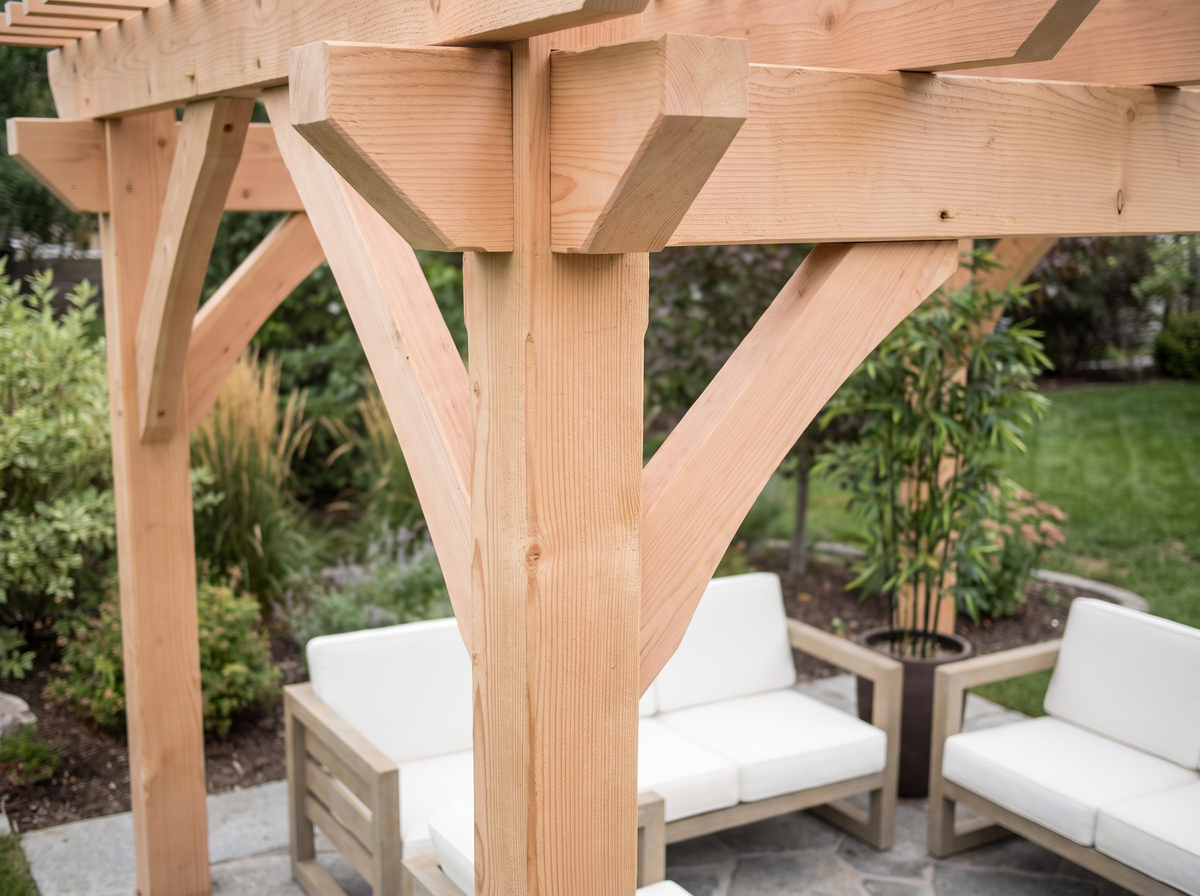
Here is what a Stillbury pergola actually is, so you can check it with a tape measure on any finished structure. Shade planks are 2 by 4 dimensional lumber laid flat at a 7 to 8 inch gap. Under them run 3 by 8 rafters on edge at 24 inches on center. Those sit on 4 by 10 beams, braced to 6 by 6 or 8 by 8 posts with knee braces, the sizes set by the span and the load. The braces and beams are cut-and-fit joinery, a tenon seated in a mortise and a brace let into the post, so the load passes through wood bearing on wood and the connection is not a bracket and a handful of lag screws. Fasteners, where they are used, are the highest exterior grade available.
The wood is fresh-milled, rough-sawn Douglas fir, and the natural finish is a muted warm tan. It is not honey gold and it is not cedar orange; if a render or a photo shows you a yellow pergola, that is not what arrives. The finish is a penetrating stain, which wears rather than peels, so recoating means cleaning and reapplying rather than stripping. A structure in full sun needs it sooner than one in shade. That recoat is the honest cost of wood, and our best-wood guide covers the schedule.
At the ground, the post stands on the welded aluminum knife plate described above, an inch or more clear of the concrete, on a footing poured below the frost line. That is the detail that separates a wood pergola that lasts decades from the one in the "10 to 15 years" statistic, and it is aluminum doing a job aluminum is better at.
Two limits, stated plainly because a reader comparing against a louvered aluminum system should know them. Stillbury does not run electrical through posts and does not install outlets, fans, or heaters; when customers want light under a structure, it is string lights. And every Stillbury structure carries a 3-year warranty, which is the figure, not a lifetime claim.
The custom-versus-catalog question underneath the material question
Most of the aluminum pergolas people compare against wood are catalog products, and the size list is the tell: 10x10, 12x12, 12x16, 12x20, 16x20. The search data for Utah is full of "12 x 20 aluminum pergola" and "16 x 20 aluminum pergola," because that is how the product is sold. You pick the nearest size and place it on your patio. A designed pergola works the other way. It starts with the patio, the house, the sun, and the way you want to sit, and the structure is drawn to fit them. Stillbury draws yours in 3D and shows it to you on your actual yard before you pay anything, which means you see the post placement, the span, and how it meets the house while it is still a drawing.
Questions to ask before you buy either one
These are the questions that separate a good version of each material from a bad one. Ask them in writing.
Ask any aluminum seller:
- Which AAMA spec is the powder coat, 2603, 2604, or 2605?
- What alloy and wall thickness are the posts and beams?
- What is the structure rated to in pounds per square foot of snow and miles per hour of wind, and does that meet my city's number?
- How is it anchored, to what, and who is responsible for that?
- If a member is dented, is the part available, for how long, and in this color?
- Does modifying it (a fan, a shade, a heater) void the warranty?
Ask any wood builder:
- What species and grade, and what size are the posts, beams, and rafters?
- What is the post base made of, and how far above the concrete does it hold the post?
- How deep are the footings, and are they below the frost line for my city?
- Is it joinery or brackets, and what grade of fastener?
- What is the finish, and how often does it need recoating in full sun?
- How many years is the warranty, and who pulls the permit?
Stillbury's answers to the second list are in the section above, and they are meant to be checked.
Wood vs aluminum pergola: how to decide
The material question is really three questions. What will you touch, and does it matter that aluminum hands you heat 1,500 times faster than wood? What will you pay, and are you comparing a lattice cover to custom timber or a louvered system to a wood pavilion? And what will you see from the kitchen window every day, a frame that matches your windows or a structure that matches your house?
If your answers point to aluminum, buy a good one: 2604 or better on the coating, a written snow rating, and a seller who will still have your part in ten years. If they point to wood, the same rule applies, and the checklist above is how to tell a good wood builder from a bad one.
If you would like to see your own pergola, on your own patio, in Douglas fir, before deciding anything, we will draw it for you in 3D and price it. The free 3D design and quote is the first step, and it costs nothing.