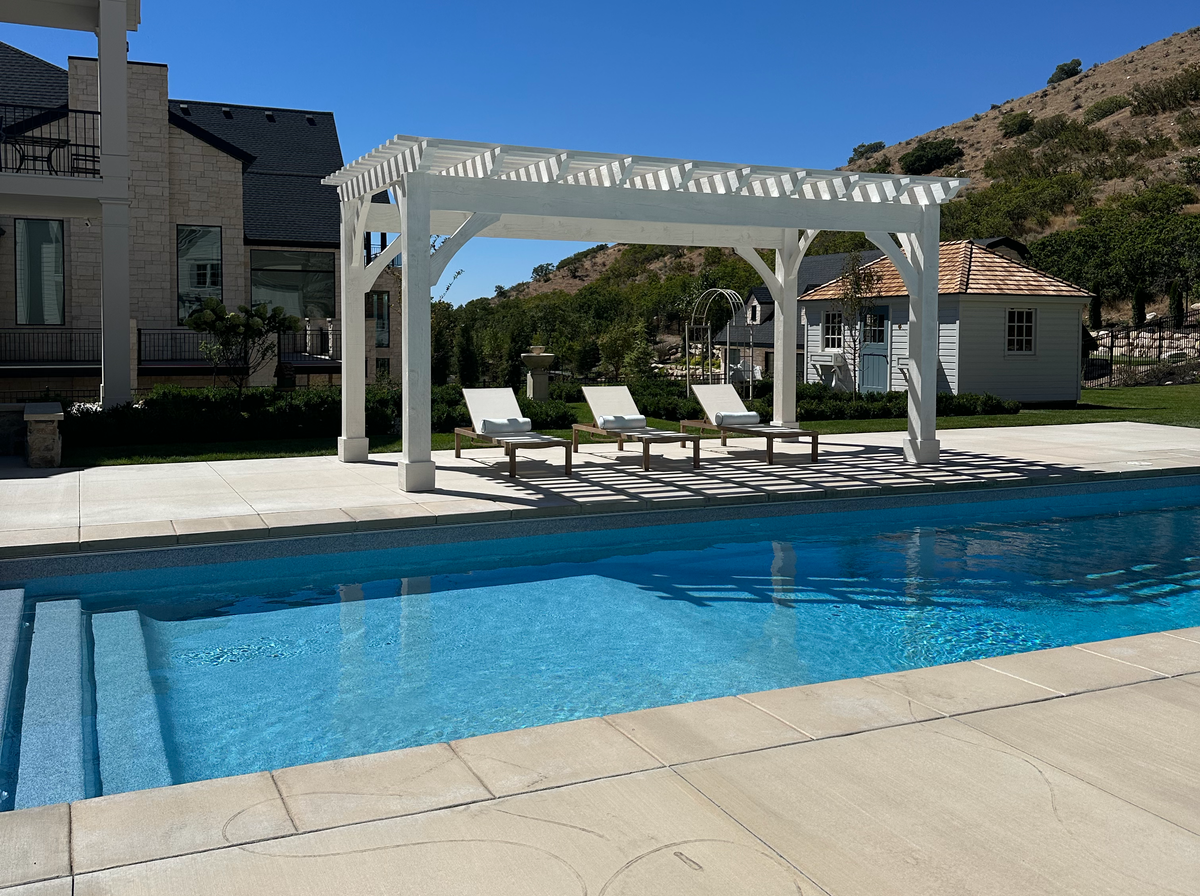
A pergola usually adds some value to a Utah home, but reliably less than it cost, and no published dataset measures a pergola on its own. Appraisers treat one as an ancillary structure: a separate line on the appraisal grid, adjusted to whatever buyers in your neighborhood actually paid for a comparable structure. This guide shows which numbers exist, which are borrowed, and what makes a pergola count.
Key takeaways
- This guide covers whether a pergola adds value to a home, how an appraiser handles one, and the four things that decide whether yours counts in Utah. For what a pergola costs, see what a custom pergola costs in Utah. For whether you need a permit, see the Utah pergola and pavilion permit guide. For a structure that was built without one, see building without a permit in Utah. For which material holds value better, see wood vs aluminum.
- No cost-recovery dataset prices a pergola by itself. Not one.
- The only authoritative report that includes a pergola bundles it into a $51,454 backyard-patio project that recovered about 46% of its cost. A 16x20 wood deck with no pergola recovered 94.9%.
- The "50% to 80% ROI" figure quoted across this subject appears in none of those reports.
- An appraiser gives a pergola its own line on the grid at contributory value, derived from comparable sales rather than from your invoice. That value can legitimately be zero.
- Four things decide whether yours counts: real footings, a permit where one was required, proportion to the house, and a patio people actually use.
Does a pergola add value to your home?
Yes, with a qualifier that matters more than the yes. A pergola set on permanent footings, permitted where a permit was required, is a real-property improvement, and an appraiser can assign it value. What an appraiser cannot do is hand it a percentage of what you spent.
The amount is set by your local market. If homes near you have sold for more because they had a comparable structure, your pergola carries value. If they have not, it carries little or none, no matter how well it was built or how much it cost.
Here is the part nobody says out loud. Every builder page, every manufacturer blog, and every AI assistant will tell you a pergola does not return dollar for dollar, and they are right. None of them can point you to a measurement of a pergola, because there isn't one. The agreement across this whole subject is real, and it is not based on data.
How much value does a pergola add?
There is no measured figure for a pergola. Two organizations publish authoritative cost-recovery data on outdoor projects in the United States, and between them they price 39 projects. A pergola appears in exactly one of those projects, bundled with six other things.
That one appearance is worth looking at closely, because it is the only evidence that exists.
| Project | What the project includes | Job cost | Resale value | Cost recouped |
|---|---|---|---|---|
| Wood deck addition | A 16x20 deck on pressure-treated joists and 4x4 posts anchored to concrete piers, with railing, stairs, a built-in bench and a planter | $18,263 | $17,323 | 94.9% |
| Composite deck addition | The same 16x20 deck in composite decking and railing | $25,096 | $22,199 | 88.5% |
| Backyard patio | A 20x20 flagstone patio and a cedar pergola with lights, plus a lift-and-slide glass door on the house, a gas fire pit, four chairs, and a stone-veneer kitchen unit with a grill, a fridge and a sink | $51,454 | $23,672 | about 46% |
Read the third row again. The pergola is one of seven line items in a $51,454 package, and the package returned less than half its cost. Its own contribution is unknowable from that figure. What the row does establish is that the one time a pergola has been priced inside a credible dataset, the project it belonged to was the weakest outdoor performer in the report.
One thing to be clear about, since that project description raises it. Stillbury builds the structure. We do not run wired power, install outlets, fans or heaters, or touch gas lines. Lighting on our structures means string lights. If your plan includes a grill run, a fridge or an outdoor kitchen, you will coordinate a licensed electrician, plumber and gas fitter separately, and we will tell you that at the design stage rather than at the end.
The other dataset, and what it does not contain. The National Association of Realtors and the National Association of Landscape Professionals publish a joint report on outdoor projects. It prices 11 of them, using cost estimates from landscape professionals and resale estimates from REALTORS®.
| Outdoor project | Cost recovered |
|---|---|
| Standard lawn care service | 217% |
| Landscape maintenance | 104% |
| Overall landscape upgrade | 100% |
| Outdoor kitchen | 100% |
| New patio, 18x16 pavers | 95% |
| New wood deck, 14x18 cedar | 89% |
| Tree care | 87% |
| Irrigation system | 83% |
| Landscape lighting | 59% |
| Fire feature | 56% |
| In-ground pool | 56% |
A pergola is not among the 11.
So where does "50% to 80%" come from? From repetition. The figure turns up on manufacturer blogs, on dealer sites, and in answers from AI assistants, and the attribution usually points at the Realtors' outdoor report. That report contains no pergola, so it cannot be the source. The 95% and the 100% that get quoted belong to a paver patio and a landscape upgrade.
The circularity is easy to see once you look for it. One louvered-pergola manufacturer cites the same Realtors' report on two different pages, once as "75% to 100%" and once as "100% or greater," for a project the report does not include. Ask a chatbot and you will often get "50% to 80%, according to the National Association of Realtors," with no citation attached at all.
None of this means a pergola is worthless. It means the number you have been given was never measured, and you should stop planning around it.
How does an appraiser actually value a pergola?
An appraiser gives a pergola its own line on the appraisal grid and adjusts it to what the local market says a comparable structure is worth. The rule is published, and it is the same rule for every lender-financed sale in the country.
Step one. It gets a separate line. Fannie Mae's Selling Guide instructs that a standalone structure which is not a dwelling unit "should be treated as any other ancillary structure and included as a separate line item in the sales comparison approach then adjusted based on its contributory value to the subject property." That phrase, *contributory value*, is the whole subject in two words. It means what this structure contributes to what a buyer will pay, which is a different question from what it cost to build.
Step two. The number comes from the market, not the invoice. The same Selling Guide requires that "the appraiser's adjustments must reflect the market's reaction (that is, market based adjustments) to the difference in the properties." It then offers a rule-of-thumb adjustment as its own example of what is *inappropriate*, because a rule of thumb is not evidence of what buyers did.
Step three. The honest answer can be zero. For what the Guide calls an atypical minimal outbuilding, a property is acceptable "provided the appraiser's analysis reflects little or no contributory value for it." An appraiser who assigns your structure nothing has not made a mistake. They have reported that the sales they studied do not show buyers paying extra.
This is why no percentage can be right, and it points at a better question than the one most people ask. Instead of "what is the ROI on a pergola," ask your agent whether homes in your neighborhood have sold for more with a comparable structure, and ask them to show you the pairs. Any agent can answer that, about any builder's structure, and the answer is specific to your street rather than to the country.
If your structure needed a permit and never got one, the appraisal question changes, and building without a permit in Utah covers what happens then.
Does a pergola add square footage to your house?
No. A pergola adds no square footage, because the measurements that drive a home's size are measurements of *finished* area, and a pergola is unfinished and unenclosed.
You will find pages claiming a pergola can count toward a home's square footage. It cannot, and the claim is worth correcting because it sets up a disappointment at appraisal. A pergola is a site improvement. It is valued as an amenity on its own grid line, never as part of the house's living area. Asked directly, most AI assistants now get this right, so if you checked with one before reading this, you probably already had the correct answer.
What makes a pergola count? Four conditions
Four things decide whether a pergola carries value: real footings, a permit where one was required, proportion to the house, and a usable space underneath it. Everything else is detail.
| Condition | Why it decides the value | What to ask before you build |
|---|---|---|
| Set on real footings | A structure fixed to the ground is a real-property improvement. A kit standing loose on pavers reads as personal property, closer to patio furniture than to a building. | What do the posts land on, and how deep? See how long a pergola lasts for what happens at the post base over time. |
| Permitted where a permit was required | A permit record is the evidence an appraiser, a buyer and a buyer's lender can all rely on. It costs very little at the time and is expensive to produce later. | The Utah permit rule, which turns on size and on whether the structure attaches to the house. |
| Proportioned to the house and the yard | An over-built structure on a modest house does not return what it cost, because appraisers adjust toward what the neighborhood supports. | How to size one to the space, and see it on a photo of your own house before you commit. |
| Covering a space people use | Value follows function. A pergola over a finished patio reads as an outdoor room. The same structure standing in the middle of a lawn reads as an object. | Plan the surface and the structure together rather than in two separate years. |
Two honest notes belong here. Douglas fir checks as it dries and wants refinishing on a cycle, so a wood structure asks more of its owner than an aluminum frame does. And no Utah appraisal source separates the resale value of a wood pergola from an aluminum one, which is why wood vs aluminum treats that comparison on its own terms rather than claiming either material adds more.
Does a pergola stay with the house when you sell?
A pergola fixed to footings normally conveys with the property, but Utah's purchase contract does not name backyard structures, so the safe move is to have your agent name yours in writing.
Utah law requires real estate licensees to use a standard Real Estate Purchase Contract. Section 1.1 of that form includes, unless excluded, "the following items if presently owned and in place on the Property," and then lists them: plumbing and HVAC equipment, solar panels, ovens and ranges, dishwashers, ceiling fans, water heaters, light fixtures, bathroom fixtures, window coverings, screens, storm doors, awnings, satellite dishes, TV mounting brackets, wall and ceiling speakers, affixed carpets, garage-door openers, the security system, and fencing and any landscaping.
Utah's purchase contract names your fence and your shrubs. It does not name your pergola.
For a structure on concrete footings this is rarely a real problem, because it has become part of the land. For a freestanding kit sitting on pavers it is genuinely ambiguous, and Section 1.2 of the same form moves personal property by a separate bill of sale. Either way the fix takes one line. Ask your agent to name the structure in the contract rather than assume it travels with the house.
Does a pergola increase your property taxes in Utah?
Possibly a little, by the same logic that governs the appraisal. A Utah county assessor appraises residential property at "100% of its fair market value," so whatever the assessor judges the structure adds to that value is what gets taxed.
The primary-residence exemption softens it. Residential properties serving as someone's primary residence "receive an exemption of 45% of fair market value," so you are taxed on 55% of whatever the assessor concludes. And a structure the market does not reward adds nothing to the assessment either, for the same reason it adds nothing to an appraisal.
Here is the limit of what anyone can tell you. No Utah assessor publishes a line-item valuation for a pergola, so no honest figure exists for what yours will do to your bill, and that includes any figure you read on a builder's website. The reliable move is to look your parcel up on your county assessor's records and call the office with the plan before you build. If a valuation does land wrong, the county Board of Equalization is the body that hears "appeals of the valuations and assessments entered on the tax roll by the assessor."
Does a pergola add more value than a deck or a patio?
On measured cost recovery, yes, a deck and a patio both beat a pergola, because a deck and a patio have measurements and a pergola does not. A 16x20 wood deck recovered 94.9% of its cost nationally and an 18x16 paver patio recovered 95%. A pergola has no figure at all.
That ranking is less useful than it looks. These are different projects solving different problems. A deck gives you a raised surface where the ground will not cooperate. A patio gives you a surface. A pergola gives you shade and a sense of enclosure over a surface you already have. Cost recovery ranks projects by how much of the money comes back, not by how much the backyard improves, and the two rankings are not the same list.
If what your yard lacks is a usable surface, build the surface first. The pergola over a finished patio is the version that reads as a room, and it is also the version that gives an appraiser something to compare. What a deck costs in Utah covers the surface side of that decision.
Should you build a pergola before you sell your house?
No. If you are listing within the year, the outdoor money goes into landscaping, and the Realtors' own data says so more bluntly than any builder will.
That report asked REALTORS® which outdoor projects they recommend to sellers before listing. The answers invert the cost-recovery table completely.
| Outdoor project | Cost recovered | Share of REALTORS® recommending it before selling |
|---|---|---|
| Landscape maintenance | 104% | 74% |
| Standard lawn care service | 217% | 53% |
| New wood deck | 89% | 9% |
| New patio | 95% | 3% |
| Outdoor kitchen | 100% | 1% |
Ninety-five percent of a patio's cost comes back, and three percent of agents would tell you to build one before you list. Both numbers are from the same report, and together they say something simple: these projects are worth doing, and not for the sale.
The sell-faster claims deserve the same treatment. A figure circulates that homes with pergolas sell 10.7 days faster. It comes from a Zillow analysis of listing-description keywords across 4.6 million sales in 2017 and 2018, where the word *pergola* ranked behind "open shelving." It measured how listings were written, not what was built. Zillow's own 2024 analysis looked at 359 features across nearly a million 2023 sales and did not place a pergola in its top ten, and Zillow's published caution is that "installing an outdoor shower or any of these individual features solely for resale may not deliver these kinds of returns." A separate "2.2% more" figure is widely repeated with no primary report behind it that we could find, so treat it as unverified rather than as evidence either way.
So the honest recommendation splits two ways. Selling this year: landscaping, lawn care, and a clean yard. Staying five or ten years: build the pergola for the summers you will use it, and treat whatever comes back at resale as the smaller half of the reason. Across all 11 outdoor projects in that report, the typical Joy Score homeowners gave was 9.7 out of 10, and that is a number with a measurement behind it.
How do you build a pergola that counts in Utah?
Three of the four value conditions are decisions made before anything is built, which is the argument for getting the design right on paper first.
Footings are a build decision, and ours are 12-inch footings with a belled flange at the base, poured below the local frost line for the city you are in. The bell is the part worth understanding. A straight column of concrete can be lifted by freezing soil gripping its sides, and the flared foot gives the frost nothing to lift against. How long a pergola lasts covers frost depth and what goes wrong at the post base when a structure skips this.
The permit record is condition two, and we prepare that package for you where a permit is needed. You submit it, which keeps the permit in your name on your property's record, and that is the version an appraiser or a buyer's lender can look up later.
Proportion is the condition a homeowner cannot check in advance any other way, and it is what the free 3D design is for. You see the structure at its real size on a photograph of your own house, from the angles you actually look at the yard from, before any money changes hands. A structure that is wrong for the house is the single most common reason an outdoor improvement does not return, and it is a cheaper thing to discover on a screen than in the yard.
Our structures are Douglas fir, milled fresh and finished for Utah sun and freeze-thaw, which reads as a muted warm tan rather than the honey-gold most people picture when they hear "fir." The joinery is cut to carry the loads rather than bolted together from catalog lumber. Our workmanship warranty runs three years from completion, covering the work being done in a good and workmanlike manner. Wood behaving like wood is not a defect, and the checking, graying and board-to-board color variation that come with real timber sit outside it.
And on the question this whole guide has circled, the honest answer is that no Stillbury structure has been through an appraisal or a resale yet. The company is new and none of the homes we have built on have changed hands. We would rather say that than point you at someone else's numbers and let you assume they are ours. When one of ours does go through an appraisal, that result will appear on this page.
If you would like to see your own structure in 3D, at the size that fits your patio, a design and a quote cost nothing. If you would rather start by working out who should build it, how to choose a pergola builder in Utah covers the licence, insurance and contract questions to ask anyone quoting you, including us.
The short version
You came here for a percentage, and the honest answer is that no one has one. What exists instead is better: a published rule that says your pergola gets its own line at contributory value, set by what buyers near you actually paid, and four conditions that decide whether that line has a number on it.
Get the footings right, pull the permit, size it to the house, and put it over a space people will use. Do those four things and the structure carries whatever your market will give it. Skip them and no amount of money spent will help.
Build it for the summers. If the appraisal rewards you later, treat that as the smaller half of the reason you built it.
If you would like to see what the right size looks like on your own house before deciding anything, a 3D design and a quote are free.
Sources
- Fannie Mae Selling Guide B4-1.3-05, Improvements Section of the Appraisal Report (06/04/2025), on ancillary structures, contributory value, outbuildings and finished area.
- Fannie Mae Selling Guide B4-1.3-09, Adjustments to Comparable Sales (06/04/2025), on market-based adjustments and rule-of-thumb adjustments.
- 2025 Cost vs. Value Report, Zonda, national averages, for the wood deck, composite deck and backyard patio projects and their descriptions. www.costvsvalue.com
- 2023 Remodeling Impact Report: Outdoor Features, National Association of REALTORS® and the National Association of Landscape Professionals, for the 11 outdoor projects, their cost recovery, Joy Scores and the share of REALTORS® recommending each before selling.
- Zillow, March 2024 analysis of 359 features across nearly one million 2023 home sales, and the earlier listing-description keyword analysis of 4.6 million 2017 and 2018 sales.
- Utah State Tax Commission, Property Tax Division, residential property, for fair-market-value assessment, the 45% primary-residence exemption and the county Board of Equalization.